 duaLab
Relative local state classifier
Project: Local state classifiers
Contents
The local state classifier relative to a geometric morphism $\gamma:\mathcal E\to\mathcal S$ is the colimit of all maps of $\mathcal E$ that are locally monic relative to $\gamma$, in the sense of Kock and Moerdijk, if this colimit exists. For $\mathcal S=\mathbf{Set}$, it is the Local state classifier of $\mathcal E$.
1. Idea§
Kock and Moerdijk introduced the maps that are locally monic relative to a geometric morphism in their study of étendues [KM91]. For a Grothendieck topos $\mathcal E$ over $\mathbf{Set}$, a map $f:A\to B$ is locally monic if and only if $A$ is covered by subobjects $U_i$ such that $f$ is monic on each $U_i$. Such a map preserves local states without collapsing them: the triangle
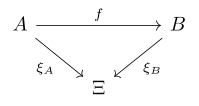
commutes, because it commutes on each $U_i$. So the local state classifier $\Xi$ of $\mathcal E$ is also the colimit of all locally monic maps (example). If we replace the monomorphisms by the maps that are locally monic relative to a geometric morphism $\gamma$, we can define a local state classifier relative to $\gamma$ in the same way, whenever the colimit exists (definition).
See §3.1 of [Horb].
2. Definition§
We recall the locally monic maps of Kock and Moerdijk and their closure properties. Then we define the relative local state classifier as the colimit of these maps.
Definition 2.1 (Locally monic map [KM91])§
Let $\gamma:\mathcal E\to\mathcal S$ be a geometric morphism. A map $f:A\to B$ in $\mathcal E$ is $\gamma$-locally monic if there are an object $I$ of $\mathcal S$, an epimorphism $q:A'\twoheadrightarrow A$ and a monomorphism $m:A'\rightarrowtail\gamma^*I\times B$ with $\pi_B m=fq$. We call $(I,q,m)$ a witness.
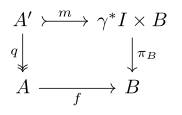
Over $\mathbf{Set}$, the object $\gamma^*I\times B$ is a coproduct of copies of $B$, and the condition says that $A$ is covered by subobjects on which $f$ is monic (example).
See Kock–Moerdijk, Definition 1.1.
Lemma 2.2 (Pullback of a witness)§☆
Let $q:A'\twoheadrightarrow A$ and $m:A'\rightarrowtail\gamma^*I\times B$ witness that $f:A\to B$ is $\gamma$-locally monic, and let $g:C\to B$. Then the pullback $f':A\times_BC\to C$ of $f$ along $g$ is $\gamma$-locally monic, witnessed by the pullback $m''$ of $m$ along $\gamma^*I\times g$.
Proof§
Define $m''$ by the middle square. The right square is a pullback, so $A''=A'\times_BC$ by pasting, formed with $fq=\pi_Bm$; hence the induced left square is a pullback too.
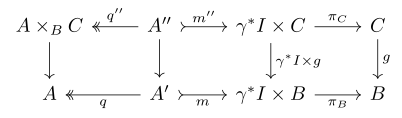
So $q''$ is epic, $m''$ is monic, and $\pi_Cm''=f'q''$.
Proposition 2.3 (Closure properties)§☆
The $\gamma$-locally monic maps contain the monomorphisms and are closed under composition and pullback.
Proof§
A monomorphism $f:A\to B$ has the witness $(1,1_A,f)$, and closure under pullback is the lemma. For composition, let $(I,q,m)$ witness $f:A\to B$ and $(J,r,n)$ witness $g:B\to C$, and pull $m$ back along $\gamma^*I\times r$:
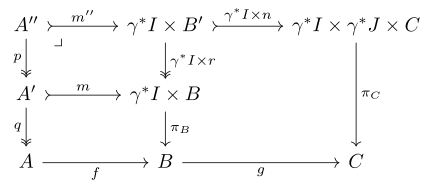
The diagram commutes because $\pi_Cn=gr$. So $qp$ is epic, $(\gamma^*I\times n)m''$ is monic, and $\pi_C(\gamma^*I\times n)m''=gfqp$; as $\gamma^*I\times\gamma^*J\cong\gamma^*(I\times J)$, this witnesses $gf$.
Definition 2.4 (Relative local state classifier)§
Let $\mathcal E_{\gamma\text{-lm}}$ be the subcategory of $\mathcal E$ with all objects and the $\gamma$-locally monic maps; it is a subcategory by the proposition. The local state classifier relative to $\gamma$ is the colimit
of the inclusion, if it exists. We write $\xi^\gamma_A:A\to\Xi_\gamma$ for the maps of its cocone.
3. Examples§
The two extreme cases are $\mathcal S=\mathbf{Set}$, which gives the local state classifier, and $\gamma=\mathrm{id}_{\mathcal E}$, which gives the terminal object.
Example 3.1 (Over Set)§
For $\gamma:\mathcal E\to\mathbf{Set}$, the relative local state classifier is the Local state classifier of $\mathcal E$, whenever one of them exists.
Proof§
Since $\gamma^*I=\coprod_I 1$, a witness $A'\rightarrowtail\coprod_I B$ splits into pieces $A'_i\rightarrowtail B$. Their images $A_i\subseteq A$ cover $A$, and $f$ is monic on each $A_i$. Hence every cocone on the monomorphisms is a cocone on the $\gamma$-locally monic maps. The converse holds because monomorphisms are $\gamma$-locally monic (proposition).
Example 3.2 (Over itself)§
For $\gamma=\mathrm{id}_{\mathcal E}$, every map $f:A\to B$ is $\gamma$-locally monic, by its graph $A\rightarrowtail A\times B$. So $\Xi_{\mathrm{id}}$ is the colimit of the identity functor, that is, the terminal object.
4. Properties§
The relative local state classifier detects the $\gamma$-locally monic maps: they are exactly the maps that preserve the relative local states.
Proposition 4.1 (Detection)§☆
Let $\gamma$ be a geometric morphism between Grothendieck topoi such that $\Xi_\gamma$ exists. Then $f:A\to B$ is $\gamma$-locally monic if and only if $\xi^\gamma_B f=\xi^\gamma_A$.
Proof§
If $f$ is $\gamma$-locally monic, the equation is the cocone condition. For the converse, call a subobject $S\subseteq X\times B$ good if $S\to B$ is $\gamma$-locally monic. Good subobjects are closed under unions, since $\gamma^*$ preserves coproducts, and under images. So $X\times B$ has a largest good subobject $R_X$, and $R_X=(h\times B)^*R_Y$ for every $\gamma$-locally monic $h:X\to Y$. Hence the classifying maps of the $R_X$, from $X$ to the power object $P(B)$, form a cocone and factor through $\Xi_\gamma$. If $\xi^\gamma_B f=\xi^\gamma_A$, then $R_A=(f\times B)^*R_B$, and the graph of $f$ factors through $R_A$, since the diagonal of $B$ is good.
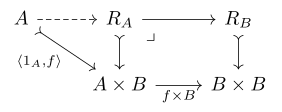
So $f$ is the composite of the monomorphism $A\rightarrowtail R_A$ and the $\gamma$-locally monic map $R_A\to B$, and it is $\gamma$-locally monic.
Corollary 4.2 (Non-singular maps)§☆
Let $\mathcal E$ be a Grothendieck topos with local state classifier $\Xi$, and let $\gamma:\mathcal E\to\mathbf{Set}$ be a geometric morphism. Then a map $f:A\to B$ of $\mathcal E$ is $\gamma$-locally monic if and only if $\xi_B f=\xi_A$. The maps with this property are the non-singular maps of Menni.
Proof§
The topos $\mathcal E$ has a local state classifier $\Xi$ (Proposition 3.21), and by the example over Set it is $\Xi_\gamma$, with the same cocone maps $\xi^\gamma_A=\xi_A$. Apply the detection proposition.
5. Open problems§
The definition assumes that the colimit exists.
Problem 5.1 (Existence)§
For which geometric morphisms $\gamma$ does $\Xi_\gamma$ exist? For example, for bounded geometric morphisms between Grothendieck topoi?
6. Related concepts§
7. References§
- [Hora] Ryuya Hora, Étendue, local state classifier, axiom of choice, unpublished draft.
- [Horb] Ryuya Hora, Local state classifier characterizes the axiom of choice, unpublished draft, §3.1.
- [Hor24] Ryuya Hora, Internal Parameterization of Hyperconnected Quotients, Theory and Applications of Categories 42 (2024), no. 11, 263–313.
- [KM91] Anders Kock and Ieke Moerdijk, Presentations of étendues, Cahiers de topologie et géométrie différentielle catégoriques 32(2) (1991), 145–164.
- [Men25] Matías Menni, Non-singular maps in toposes with a local state classifier, arXiv:2505.07131.