 duaLab
Local state classifier relative to an orthogonal factorization system
Project: Local state classifiers
Contents
For a category with an orthogonal factorization system $(\mathcal E,\mathcal M)$, the $\mathcal M$-local state classifier is the colimit of all maps in $\mathcal M$. The Local state classifier is the case of the monomorphisms. For total categories, there is a simple and conceptual existence theorem (proposition).
1. Idea§
Every Grothendieck topos has a local state classifier. For the sheaves on a site, it is the sheafification of the presheaf that sends an object $c$ to the set of quotient objects of the sheafified representable of $c$ (Proposition 3.21). This construction is technical and does not give a conceptual understanding. Two classical notions make it clearer.
- Orthogonal factorization systems: the colimit of all monomorphisms generalizes to the colimit of the right class $\mathcal M$ of an orthogonal factorization system $(\mathcal E,\mathcal M)$, and the quotient objects generalize to the maps in $\mathcal E$.
- Total categories, that is, categories whose Yoneda embedding $y$ has a left adjoint $L$: the sheaf-theoretic construction works in every total category.
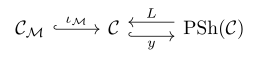
The result is the formula $\Xi_{\mathcal M}\cong L(\mathrm{Quo}_{\mathcal E})$ of the proposition, in which $\mathrm{Quo}_{\mathcal E}$ is the presheaf of the maps in $\mathcal E$ out of an object.
See the abstract and §1 of [HI].
2. Definition§
Let $\mathcal C$ be a category with an orthogonal factorization system $(\mathcal E,\mathcal M)$. We call the maps in $\mathcal E$ the $\mathcal E$-maps, and the maps in $\mathcal M$ the $\mathcal M$-maps.
Definition 2.1 ($\mathcal M$-local state classifier)§
Let $\iota_{\mathcal M}:\mathcal C_{\mathcal M}\hookrightarrow\mathcal C$ be the inclusion of the subcategory with all objects and the $\mathcal M$-maps. The $\mathcal M$-local state classifier is the colimit of this inclusion,
if it exists.
Definition 2.2 (Presheaf of $\mathcal E$-quotients)§
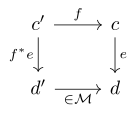
Suppose that, for every object $c$, the isomorphism classes of $\mathcal E$-maps out of $c$ form a set $\mathrm{Quo}_{\mathcal E}(c)$. Then $\mathrm{Quo}_{\mathcal E}$ is a presheaf on $\mathcal C$: a map $f:c'\to c$ sends the class of an $\mathcal E$-map $e:c\to d$ to the class of the $\mathcal E$-part $f^*e$ of $e\circ f$.
3. Examples§
The table lists three factorization systems and their local state classifiers.
Example 3.1 (Monomorphisms)§
In a topos with the (epi, mono) factorization, the $\mathcal M$-local state classifier is the Local state classifier, and $\mathrm{Quo}_{\mathcal E}(c)$ is the set of quotient objects of $c$.
Example 3.2 (All maps)§
In every category, the isomorphisms and all maps form an orthogonal factorization system. For this system, $\Xi_{\mathcal M}$ is the colimit of the identity functor, that is, the terminal object if it exists.
4. Properties§
We compute the colimit of the $\mathcal M$-maps in two steps. In presheaves, it is $\mathrm{Quo}_{\mathcal E}$. In a total category $\mathcal C$, we then apply the left adjoint of the Yoneda embedding.
Lemma 4.1 (Quo as a colimit)§☆
Let $y:\mathcal C\to\mathrm{PSh}(\mathcal C)$ be the Yoneda embedding, and suppose that the $\mathcal E$-quotients of every object form a set. Then, in presheaves on $\mathcal C$,
Proof§
The colimit at $c$ is the set of connected components of the comma category $c\downarrow\iota_{\mathcal M}$. Its objects are the maps $g:c\to d$, and its morphisms are the $\mathcal M$-maps under $c$. A map $g$ with factorization $g=me$ is connected to its $\mathcal E$-part $e$ by the $\mathcal M$-map $m$.
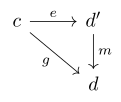
And $\mathcal E$-maps in one component are isomorphic, by the uniqueness of factorizations.
Remark 4.2 (Comprehensive factorization)§
Equivalently, $\mathrm{Quo}_{\mathcal E}$ is the presheaf of the discrete fibration in the comprehensive factorization of $\iota_{\mathcal M}$. This was pointed out by Yuto Ikeda.
Proposition 4.3 (Total categories)§☆
Let $\mathcal C$ be a total category, with left adjoint $L$ of the Yoneda embedding, and suppose that the $\mathcal E$-quotients of every object form a set. Then the $\mathcal M$-local state classifier exists, and
Proof§
The functor $L$ preserves colimits, and $L\circ y\cong\mathrm{id}$ because $y$ is fully faithful. So $L(\mathrm{Quo}_{\mathcal E})\cong\operatorname{colim}\iota_{\mathcal M}$ by the lemma above.
Corollary 4.4 (Locally presentable categories)§☆
Every locally presentable category has a local state classifier, for the (strong epi, mono) factorization.
Proof§
A locally presentable category $\mathcal C$ is complete and well-powered, so the (strong epi, mono) prefactorization system is an orthogonal factorization system. It is total, and it is well-copowered, so the strong-epi quotients of each object form a set. By the proposition on total categories, $\Xi_{\mathcal M}$ exists for $\mathcal M$ the monomorphisms, and it is the colimit of $\mathcal C_{\mathrm{mono}}\hookrightarrow\mathcal C$, that is, the Local state classifier.
5. Related concepts§
- Local state classifier · Relative local state classifier
- Terminal object as a colimit in Left-right reversal of universality
6. References§
- [HI] Ryuya Hora and Yuto Ikeda, Local state classifiers relative to factorisation systems, unpublished draft.
- [Hor24] Ryuya Hora, Internal Parameterization of Hyperconnected Quotients, Theory and Applications of Categories 42 (2024), no. 11, 263–313.
- [SW73] Ross Street and Robert Walters, The comprehensive factorization of a functor, Bull. Amer. Math. Soc. 79 (1973), 936–941.