 duaLab
Left-right reversal of universality
Contents
An object or arrow defined by a right universal property, receiving arrows, sometimes also has a left universal property, sending arrows, and vice versa. This happens especially when some kind of totality or absoluteness is involved. We collect examples and ask what this reversal is.
1. Idea§
The typical example is the terminal object of a category $\mathcal C$. Its definition is a right universal property: every object has exactly one arrow to it. But it is also the colimit of the identity functor of $\mathcal C$, and this is a left universal property. The same happens for right adjoints, for splittings of idempotents, for suprema in posets and for initial algebras.
What exactly is this reversal? Hora's interest in the question comes from the Local state classifier: it is a colimit of all monomorphisms, and a right universal property of it is sought (question).
See [Hor25].
2. Examples§
Each example gives both universal properties of one object.
Example 2.1 (Terminal object)§
An object of a category $\mathcal C$ is terminal if and only if it is a colimit of the identity functor $\mathrm{id}_{\mathcal C}$; see the dual statement at initial object. Likewise, a limit of a diagram is a terminal cone, so it is the colimit of the forgetful functor from the category of cones.
Example 2.2 (Adjoints)§
A functor $f\colon\mathcal A\to\mathcal B$ has a right adjoint $u$ if and only if the left Kan extension $\mathrm{Lan}_f\mathrm{id}_{\mathcal A}$ exists and $f$ preserves it. Then $u\cong\mathrm{Lan}_f\mathrm{id}_{\mathcal A}$, and this Kan extension is absolute, that is, every functor preserves it. This is the dual of [Mac98, Theorem X.7.2]. For $\mathcal B=1$, preservation by $f$ is automatic, and the right adjoint is the terminal object of $\mathcal A$: the pointwise formula for the left Kan extension gives the colimit of $\mathrm{id}_{\mathcal A}$, as in the first example.
Example 2.3 (Split idempotents)§
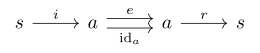
A splitting of an idempotent $e\colon a\to a$ consists of arrows $r\colon a\to s$ and $i\colon s\to a$ with $ri=\mathrm{id}_s$ and $ir=e$. Then $i$ is an equalizer of $e$ and $\mathrm{id}_a$, and $r$ is a coequalizer of $e$ and $\mathrm{id}_a$.
Fact 2.4 (Absolute colimits are limits [Par71, Str83, KS05])§
A colimit weighted by an absolute weight is also a limit, weighted by the right adjoint of that weight in Prof. This generalizes the split idempotent example.
See Paré; Street; Kelly–Schmitt, §6 and Proposition 7.3.
varkor pointed this out on MathOverflow.
Example 2.5 (Posets)§
In a poset the supremum of a subset is the infimum of its upper bounds, so a poset is complete if and only if it is cocomplete. In type theory the same idea underlies impredicative encodings of inductive types. Peter LeFanu Lumsdaine recalled both on MathOverflow.
Example 2.6 (Initial algebras)§
The initial algebra of an endofunctor is a terminal recursive coalgebra (Capretta–Uustalu–Vene, Proposition 2).
3. Absolute Kan extensions§
Adjunctions and absolute limits and colimits are special cases of absolute Kan extensions, that is, of Kan extensions that every functor preserves. So we ask whether the examples of adjoints and of split idempotents are instances of one statement on absolute Kan extensions (question).
Definition 3.1 (Notation for Kan extensions)§
For a functor $f\colon\mathcal A\to\mathcal B$, we write $\bar f\colon\bar{\mathcal A}\to\bar{\mathcal B}$ for the induced functor between Cauchy completions. The pointwise left Kan extension of $g\colon\mathcal A\to\mathcal C$ along $f$ is the weighted colimit $\mathrm{Lan}_fg(b)=\mathcal B(f-,b)\star g$.
Proposition 3.2 (Absolute left Kan extensions)§☆
Let $f\colon\mathcal A\to\mathcal B$ be a functor with $\mathcal A$ small. The following are equivalent.
- (i) For every functor $g\colon\mathcal A\to\mathcal C$, the pointwise left Kan extension of $g$ along $f$ is absolute whenever it exists.
- (ii) For every object $b$ of $\mathcal B$, the presheaf $\mathcal B(f-,b)$ is a retract of a representable presheaf.
- (iii) $\bar f$ has a right adjoint $\bar u$.
In this case each $\mathrm{Lan}_fg(b)$ is also the limit of $g$ weighted by the right adjoint of $\mathcal B(f-,b)$ in Prof, and $\mathrm{Lan}_fg\cong\bar g\,\bar u$ on $\mathcal B$ when $\mathcal C$ is Cauchy complete.
Proof§
A weight is absolute exactly when it is a retract of a representable (Street; Kelly–Schmitt, Theorem 6.22), so (ii) implies (i). Conversely, apply (i) to the Yoneda embedding $y$: the colimit $\mathrm{Lan}_fy(b)=\mathcal B(f-,b)$ is preserved by the functor that $\mathcal B(f-,b)$ represents, which gives (ii) by [KS05, Proposition 6.14]. For (ii)⇔(iii), $\bar f$ is a restriction of the left adjoint $f_!$ of $f^*\colon[\mathcal B^{\mathrm{op}},\mathbf{Set}]\to[\mathcal A^{\mathrm{op}},\mathbf{Set}]$, and (ii) says exactly that $f^*$ restricts to a functor $\bar{\mathcal B}\to\bar{\mathcal A}$. The limit formula follows from [KS05, 6.19].
Remark 3.3 (Instances)§
If $f$ has a right adjoint $u$, then $\mathcal B(f-,b)\cong\mathcal A(-,ub)$ and $\mathrm{Lan}_fg\cong gu$. Taking $g=\mathrm{id}_{\mathcal A}$ gives the adjoint example, and $\mathcal B=1$ gives the terminal object. If $\mathcal B=1$, condition (iii) says that $\bar{\mathcal A}$ has a terminal object; for the walking idempotent it is the formal splitting, which gives the split idempotent example.
4. Open problems§
The first question is the one of the Idea. The second question is the case that it comes from.
Question 4.1 (Left–right reversal)§
Hora asked on MathOverflow: "In category theory, I feel that there is a kind of 'left–right reversal' phenomena … what exactly is this reversal? For example, is it something that is conceptually understood in modern formal category theory?" Having learned that absolute limits are absolute colimits, he added: "Given that both adjunctions and absolute limits are special cases of absolute Kan extensions, I wonder whether those two phenomena can be unified into a theorem on absolute Kan extensions."
Remark 4.2 (Status)§
In a comment there, Peter LeFanu Lumsdaine called the adjoint examples well known but knew no formally unifying analysis, and regarded split idempotents as a different phenomenon. The proposition is a candidate answer to the second part. A framework that also covers the initial algebra example and the next question is still missing.
Question 4.3 (Right universal property of the local state classifier)§
The Local state classifier is defined by a left universal property, as a colimit of all monomorphisms, whereas the internal language of a topos is built from right universal properties. So describing it in the internal language amounts to finding a new universal property of it [Hora, research notes, 2023]. Which right universal property characterizes it?
Fact 4.4 (Reflexive graphs [Men25])§
In the topos of reflexive graphs, the local state classifier is a limit, a variant of a subobject classifier.
See Menni.
Remark 4.5 (Not absolute)§
The colimit defining the local state classifier is not absolute, that is, some functor does not preserve it. In $\mathbf{Set}$ this colimit is a singleton, but the colimit of $\mathbf{Set}(2,-)$ over all monomorphisms has two elements. So the proposition does not apply.
5. Related concepts§
6. References§
- [Hor25] Ryuya Hora, left–right reversal in category theory, MathOverflow question 499555 (2025), with comments by varkor and Peter LeFanu Lumsdaine.
- [Mac98] Saunders Mac Lane, Categories for the Working Mathematician, 2nd ed., Graduate Texts in Mathematics 5, Springer (1998), §X.7.
- [Par71] Robert Paré, On absolute colimits, Journal of Algebra 19 (1971), 80–95.
- [Str83] Ross Street, Absolute colimits in enriched categories, Cahiers de topologie et géométrie différentielle catégoriques 24 (1983), 377–379.
- [KS05] G. M. Kelly and V. Schmitt, Notes on enriched categories with colimits of some class, Theory and Applications of Categories 14 (2005), no. 17, 399–423, §6.
- [AFS18] Steve Awodey, Jonas Frey and Sam Speight, Impredicative encodings of (higher) inductive types, LICS 2018.
- [CUV06] Venanzio Capretta, Tarmo Uustalu and Varmo Vene, Recursive coalgebras from comonads, Information and Computation 204 (2006), no. 4, 437–468.
- [Men25] Matías Menni, Non-singular maps in toposes with a local state classifier, arXiv:2505.07131.
- [Hor24] Ryuya Hora, Internal Parameterization of Hyperconnected Quotients, Theory and Applications of Categories 42 (2024), no. 11, 263–313.