 duaLab
Space rtimes time as relative topos
Project: Topos-theoretic dynamical system theories
Contents
The geometry of Conway's Game of Life is neither a topological space nor a discrete dynamical system: its space depends on time. This programme captures such geometry, $\mathrm{Space}\rtimes\mathrm{Time}$ rather than $\mathrm{Space}\times\mathrm{Time}$, by relative topoi: topoi over a base topos of dynamical systems.
1. Idea§
The starting point is the sentence "a glider moves to the upper right". In the Game of Life, each cell of $\mathbb Z^2$ evolves in time by looking only at the blinking of its neighbourhood. The left picture shows the live cells of a glider, and the right picture the live cells four steps later: the same pattern, one cell further up and to the right.
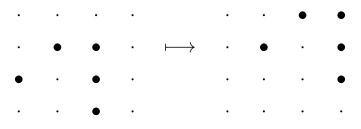
Which geometric structure on $\mathbb Z^2$ makes this sentence possible? A topology on $\mathbb Z^2$ alone does not show the time evolution. The Life map $\mathcal P(\mathbb Z^2)\to\mathcal P(\mathbb Z^2)$ alone, which is a discrete dynamical system, does not show the space. The cells of $\mathbb Z^2$ are connected in space through their interaction in the time evolution.
A relative topos over a topos $\mathcal S$ is a topos $\mathcal E$ with a geometric morphism $\mathcal E\to\mathcal S$. Ordinary geometry is a topos over $\mathbf{Set}$, such as $\mathbf{Sh}(X)\to\mathbf{Set}$ for a topological space $X$. Time-dependent geometry is a topos over the topos of discrete dynamical systems. Its global sections are dynamical systems, not sets.
A pretopology $\mathrm{Int}$ is a non-idempotent interior operator, a dynamical version of a topology. In the Game of Life, the state on a set $S$ of cells determines the next state only on the smaller set $\mathrm{Int}(S)$. When space is considered inside the time evolution in this way, we get the dependence $\mathrm{Space}\rtimes\mathrm{Time}$, and not the product $\mathrm{Space}\times\mathrm{Time}$.
2. The relative topos§
The construction and its proofs are given in Dynamical presheaf. The results are the following.
Remark 2.1 (Dynamical presheaves)§
The dynamical presheaves of a pretopology $\mathrm{Int}$ on a set $X$ are the presheaves on the category $\mathcal P(X)\rtimes_{\mathrm{Int}}\mathbb N$, and they form a topos $\mathbf{dPSh}(X,\mathrm{Int})$ over the topos of discrete dynamical systems.
See Presheaves and Relative topos.
Example 2.2 (Game of Life)§
The Game of Life is an object of the topos $\mathbf{dPSh}(\mathbb Z^2,\mathrm{Int})$ of dynamical presheaves, and its global sections are the Life map $\mathcal P(\mathbb Z^2)\to\mathcal P(\mathbb Z^2)$.
See Game of Life and Global sections.
3. Open questions§
The distant aim is a structural model of natural selection: to understand how individuals, "the same thing moving", emerge from a system that has only space and time evolution. The construction above is a first step.
Question 3.1 (Sheaf condition)§
Let $\mathcal P_{\mathrm{fin}}(\mathbb Z^2)$ be the poset of finite subsets of $\mathbb Z^2$. What is the largest topology $J$ on $\mathcal P_{\mathrm{fin}}(\mathbb Z^2)\rtimes_{\mathrm{Int}}\mathbb N$ for which the Game of Life is a sheaf, that is, the smallest subtopos containing it?
Question 3.2 (Logic)§
How can "a glider moves to the upper right" be formulated with non-idempotent modal operators?
Question 3.3 (Symmetry)§
The group $\mathbb Z^2\rtimes D_4$ of symmetries of the lattice acts on the topos $\mathbf{dPSh}(\mathbb Z^2,\mathrm{Int})$. What is the quotient by this symmetry?
Question 3.4 (Smooth version)§
Can the wave equation be captured as a topos over $\mathsf{SmoothSet}^{\mathbb R_{\geq0}}$, the topos of smooth sets with an action of the monoid $\mathbb R_{\ge 0}$ of times?
Question 3.5 (Individuality)§
How do individuals emerge in a topos over discrete dynamical systems?
4. Knowledge that depends on time§
In an epistemic puzzle, what an agent knows depends on time.
Example 4.1 (Hat puzzle)§
Two prisoners each wear a hat. The hats are drawn from one red hat and two blue hats. Initially each prisoner sees only the other's hat. Both know the stock of hats, what each can see, and the announcement rule. Each simultaneously states their own colour if they know it, or says they are unsure.
See Ryuya Hora, Epistemic puzzles in topoi, § “The puzzle revisited” (October 2024).
Proposition 4.2 (Learning the hat colour after one announcement)§☆
In the hat puzzle, suppose both hats are blue. Neither prisoner initially knows their own colour. After the first simultaneous announcement, both know their own hat is blue.
Proof§
Each prisoner sees a blue hat, so either colour is possible for their own. Thus both announce that they are unsure. Had a prisoner's hat been red, the other would have seen the only red hat and announced blue. Hearing the other say they are unsure therefore rules out red.
Remark 4.3 (Time-dependent knowledge)§
What each prisoner knows changes when the public announcements are heard. This is the same information update used in the muddy children puzzle. See Fagin–Halpern–Moses–Vardi, Reasoning About Knowledge, 1995, Ch. 1–2.
Remark 4.4 (Knowledge modalities)§
The hat puzzle can be formalized with modal operators $\Box_{a,n}$, read "agent $a$ knows at time $n$". They are indexed by the product $O$ of a poset of agents and $\mathbb N$. Each $\Box_o$ satisfies the rules of the modal logic S4, and $\Box_{o}\phi\to\Box_{o'}\phi$ holds for $o\le o'$ in $O$.
See Ryuya Hora, Epistemic puzzles in topoi, unpublished draft (October 2024).
Question 4.5 (Epistemic puzzles)§
Can such puzzles be solved through the Booleanization of an "interaction topos", in which the way-above relation between levels ($o$-skeletal objects are $o'$-coskeletal) says that $o'$ knows the ignorance of $o$?
See Ryuya Hora, Epistemic puzzles in topoi, unpublished draft (October 2024).
5. Related concepts§
6. References§
- [Hor26] Ryuya Hora, Space ⋊ Time for Conway's Game of Life, slides (in Japanese), talk at CSCAT 2026.
- [Hor24] Ryuya Hora, A space ⋊ time for Conway's game of life, note based on the Category Theory Advent Calendar 2024; the public version has Sections 1–6.
- [Tom20] Ivan Tomašić, A topos-theoretic view of difference algebra, arXiv:2001.09075.