 duaLab
Dynamical presheaf
Project: Topos-theoretic dynamical system theories
Contents
A dynamical presheaf is a presheaf on the subsets of a set in which a section over a subset $S$ evolves to a section over a smaller subset $\mathrm{Int}(S)$. Dynamical presheaves are proposed as a first, not conclusive, description of the geometry of Conway's Game of Life: in that game, the present state of a region determines the next state only on the interior of the region.
1. Idea§
In Conway's Game of Life, the next state of a cell of $\mathbb Z^2$ is determined by the present states of the cell and of its eight neighbours. So the rule is local: a state on a subset $S\subseteq\mathbb Z^2$ determines the next state only on the set $\mathrm{Int}(S)$ of the cells of $S$ whose eight neighbours all lie in $S$.
The operator $\mathrm{Int}$ is like the interior operator of a topology, but it is not idempotent: the set $\mathrm{Int}(\mathrm{Int}(S))$ is in general smaller than $\mathrm{Int}(S)$. Such an operator is a pretopology, a dynamical version of a topology. No topology on $\mathbb Z^2$ is suitable here: for example, if the set formed by a cell and its eight neighbours is open for every cell, then the topology is discrete.
A dynamical presheaf is a presheaf $F$ with maps $F(S)\to F(\mathrm{Int}\,S)$, and the Game of Life is the example $F(S)=\mathcal P(S)$. The dynamical presheaves form a presheaf topos. This topos lies over the topos of discrete dynamical systems: the global sections of a dynamical presheaf are a dynamical system, and for the Game of Life they are the Life map on $\mathcal P(\mathbb Z^2)$.
2. Definition§
A topology on a set $X$ is the same as an interior operator: a map $\mathrm{Int}:\mathcal P(X)\to\mathcal P(X)$ that preserves finite intersections, satisfies $\mathrm{Int}(S)\subseteq S$ and is idempotent. A pretopology drops the idempotence.
Definition 2.1 (Pretopology)§
A pretopology on a set $X$ is a map $\mathrm{Int}:\mathcal P(X)\to\mathcal P(X)$ such that for all subsets $S$ and $T$ of $X$
In particular $\mathrm{Int}$ preserves inclusions. The topologies are the pretopologies with $\mathrm{Int}\circ\mathrm{Int}=\mathrm{Int}$; compare pretopological space.
See Definition 4.2.
Example 2.2 (Graphs)§
Every directed graph with vertex set $V$ defines a pretopology on $V$ by
See Example 4.4.
Definition 2.3 (Dynamical presheaf)§
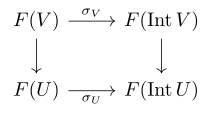
A dynamical presheaf on $(X,\mathrm{Int})$ is a presheaf $F:\mathcal P(X)^{\mathrm{op}}\to\mathbf{Set}$ on the poset of subsets of $X$, with a map $\sigma_S:F(S)\to F(\mathrm{Int}\,S)$ for each subset $S$, such that the following square commutes for all $T\subseteq S$. Its vertical maps are restrictions.
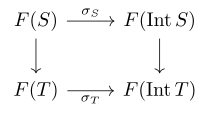
A morphism of dynamical presheaves is a morphism of presheaves that commutes with the maps $\sigma_S$. We write $\mathbf{dPSh}(X,\mathrm{Int})$ for the category of dynamical presheaves.
See Definition 5.1.
Definition 2.4 (Grothendieck construction of Int)§
The category $\mathcal P(X)\rtimes_{\mathrm{Int}}\mathbb N$ is the Grothendieck construction of $\mathrm{Int}$, viewed as a functor $\mathbb N\to\mathbf{Cat}$. Its objects are the subsets of $X$, a morphism $U\to V$ is an $n\in\mathbb N$ with $U\subseteq\mathrm{Int}^n(V)$, and the composite of $U\xrightarrow{n}V\xrightarrow{m}W$ is $U\xrightarrow{n+m}W$.
See Definition 5.3.
3. Examples§
The Game of Life is the example for which dynamical presheaves were defined.
Example 3.1 (Game of Life)§
For a cell $c\in\mathbb Z^2$, let $N_c$ be the set of nine cells formed by $c$ and its eight neighbours.
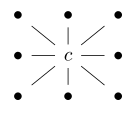
Let $\mathrm{Int}(S)=\{c\mid N_c\subseteq S\}$; this is the pretopology of the graph in which every cell is joined to its eight neighbours. Conway's Game of Life is the dynamical presheaf $F(S)=\mathcal P(S)$: a section over $S$ is the set $A\subseteq S$ of live cells. The map $\sigma_S$ is the Life rule: a cell $c\in\mathrm{Int}(S)$ is live in $\sigma_S(A)$ exactly when $\#(N_c\cap A)=3$, or $c\in A$ and $\#(N_c\cap A)=4$.
4. Properties§
The dynamical presheaves are the presheaves on the category $\mathcal P(X)\rtimes_{\mathrm{Int}}\mathbb N$, so they form a topos. This topos lies over the topos of discrete dynamical systems.
Lemma 4.1 (Generators)§☆
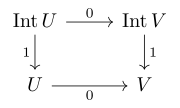
Suppose that $\mathrm{Int}$ preserves inclusions, and write $\mathcal G=\mathcal P(X)\rtimes_{\mathrm{Int}}\mathbb N$. Every morphism $U\xrightarrow{n}V$ of $\mathcal G$ is the composite
and for $U\subseteq V$ the following square commutes.
Proof§
Composition adds labels; it is well defined because $U\subseteq\mathrm{Int}^nV$ and $V\subseteq\mathrm{Int}^mW$ give $U\subseteq\mathrm{Int}^{n+m}W$. A morphism is determined by its source, target and label, so two parallel composites with the same sum of labels are equal. The sum is $n$ for the chain, and $1$ for both sides of the square.
Lemma 4.2 (Extension)§☆
Suppose that $\mathrm{Int}$ preserves inclusions. For a dynamical presheaf $(F,\sigma)$, write
Then
defines a presheaf $G$ on $\mathcal P(X)\rtimes_{\mathrm{Int}}\mathbb N$ with $G(U)=F(U)$.
Proof§
Identities are preserved, since $\sigma^{(0)}$ is the identity. For $U\xrightarrow{n}V\xrightarrow{m}W$, the following diagram, whose vertical maps are restrictions, commutes because $\sigma$ commutes with restrictions.
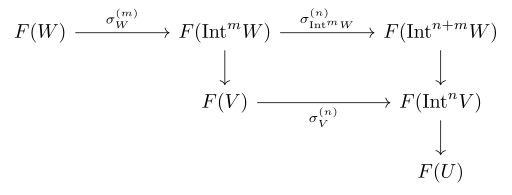
The path through $F(\mathrm{Int}^{n+m}W)$ is $G(n+m)$, and the path through $F(V)$ is $G(n)\circ G(m)$.
Proposition 4.3 (Presheaves)§☆
For every pretopology $\mathrm{Int}$ on a set $X$, there is an equivalence of categories
It suffices that $\mathrm{Int}$ preserves inclusions.
See Proposition 5.4.
Proof§
We restrict presheaves on $\mathcal G=\mathcal P(X)\rtimes_{\mathrm{Int}}\mathbb N$ along its generators. The morphisms with label $0$ turn a presheaf $G$ on $\mathcal G$ into a presheaf $F$ on $\mathcal P(X)$, and the maps $\sigma_V=G(\mathrm{Int}\,V\xrightarrow{1}V)$ commute with restrictions by the square of the lemma. Conversely, a dynamical presheaf $(F,\sigma)$ extends to $\mathcal G$. By the chain of the lemma, the two constructions are mutually inverse, and the morphisms of presheaves on $\mathcal G$ are the morphisms on $\mathcal P(X)$ compatible with $\sigma$.
Lemma 4.4 (Internal presheaves)§☆
Suppose that $\mathrm{Int}$ preserves inclusions, so that $\{(U,V)\mid U\subseteq V\}$ is closed under $\mathrm{Int}\times\mathrm{Int}$ and makes $(\mathcal P(X),\mathrm{Int})$ an internal poset in sets with an endomap. Its internal presheaves $p:(E,\sigma)\to(\mathcal P(X),\mathrm{Int})$ correspond to the dynamical presheaves $F$, by $F(U)=p^{-1}(U)$.
Proof§
The order relation is a subobject of the square whose structure maps are equivariant, hence an internal poset. Equivariance of $p$ says that $\sigma$ maps $F(U)$ to $F(\mathrm{Int}\,U)$. The action of the order relation on $E$ is a family of maps $F(V)\to F(U)$ for $U\subseteq V$, and its axioms say that $F$ is a presheaf on $\mathcal P(X)$. Equivariance of the action is the commutativity of the following squares. Morphisms correspond in the same way.
Proposition 4.5 (Relative topos)§☆
The pair $(\mathcal P(X),\mathrm{Int})$ is an internal poset in the topos of discrete dynamical systems, and dynamical presheaves are its internal presheaves. Hence $\mathbf{dPSh}(X,\mathrm{Int})$ is a topos over the topos of discrete dynamical systems, that is, it has a geometric morphism to that topos. This is a special case of Tomašić, §§13.13–13.16.
Proof§
The first sentence is the lemma, since a discrete dynamical system is a set with an endomap. For the second, discrete dynamical systems form the presheaf topos $\mathbf{PSh}(\mathbb N)$, and the projection $\pi$ from $\mathcal P(X)\rtimes_{\mathrm{Int}}\mathbb N$ to $\mathbb N$, sending $U\xrightarrow{n}V$ to $n$, induces $\pi_!\dashv\pi^*\dashv\pi_*$ by Kan extension. Under the equivalence, $(\pi^*,\pi_*)$ is a geometric morphism from $\mathbf{dPSh}(X,\mathrm{Int})$ to $\mathbf{PSh}(\mathbb N)$.
Remark 4.6 (Global sections)§
Let $\gamma$ be the geometric morphism $(\pi^*,\pi_*)$ from $\mathbf{dPSh}(X,\mathrm{Int})$ to $\mathbf{PSh}(\mathbb N)$ of the proof above. Its direct image $\gamma_*$ evaluates at $X$: it sends $(F,\sigma)$ to the set $F(X)$ with the map $\sigma_X:F(X)\to F(\mathrm{Int}\,X)=F(X)$. For the Game of Life, this system is the Life map $\mathcal P(\mathbb Z^2)\to\mathcal P(\mathbb Z^2)$.
See Proposition 6.4.
5. Related concepts§
6. References§
- [Hor24] Ryuya Hora, A space ⋊ time for Conway's game of life, note based on the Category Theory Advent Calendar 2024; the public version has Sections 1–6.
- [Tom20] Ivan Tomašić, A topos-theoretic view of difference algebra, arXiv:2001.09075.