 duaLab
Perfect internal algebra
Project: Local state classifiers
Contents
An algebra inside a topos gives a Galois connection between the hyperconnected quotients of the topos and the subalgebras of the algebra. The algebra is perfect when this Galois connection is an equivalence. Finite Galois theory is an example: a Galois extension $K/\mathbb Q$ is a perfect algebra in the topos of $\operatorname{Gal}(K/\mathbb Q)$-sets. The Syntactic topos comes from the same kind of Galois connection, between hyperconnected quotients of the topos of $\Sigma$-sets and classes of languages.
1. Idea§
A hyperconnected quotient $k$ of a topos $\mathcal E$ can be regarded as a full subcategory of $\mathcal E$, and every object $A$ has a largest subobject in this subcategory, the counit $k^*k_*A\rightarrowtail A$. If $A$ is an algebra for a finitary theory, then this subobject is a subalgebra. So every hyperconnected quotient gives a subalgebra of $A$, and every subalgebra generates a hyperconnected quotient. For a Galois extension, this is the correspondence of Galois theory. For the set of all languages, it is the correspondence between hyperconnected quotients and the classes of languages that they recognize; these classes are quotient-stable, that is, closed under $L\mapsto w^{-1}L$.
The two maps are described in the lemma. The Galois connection and the example of Galois theory are stated in the Appendix of [Hor].
2. Definition§
The Galois connection is stated for every equational theory. Its two maps are written out for finitary theories.
Proposition 2.1 (Galois connection)§☆
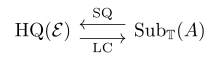
Let $\mathcal E$ be a Grothendieck topos, $\mathbb T$ an equational theory and $A$ an internal $\mathbb T$-algebra in $\mathcal E$. There is a Galois connection between the complete lattice $\mathrm{HQ}(\mathcal E)$ of hyperconnected quotients of $\mathcal E$ and the complete lattice $\mathrm{Sub}_{\mathbb T}(A)$ of sub-$\mathbb T$-algebras of $A$. See [Hor, Appendix].
Definition 2.2 (The two maps)§
Let $\mathbb T$ be finitary. For a hyperconnected quotient $k$ of $\mathcal E$, we write $\mathrm{LC}(k)$ for the subalgebra $k^*k_*A\subseteq A$. For a subalgebra $B\subseteq A$, we write $\mathrm{SQ}(B)$ for the least hyperconnected quotient of $\mathcal E$ that contains $B$. We take the Galois connection to be this pair of maps.
Definition 2.3 (Perfect algebra)§
An internal $\mathbb T$-algebra $A$ in a Grothendieck topos $\mathcal E$ is perfect if the Galois connection is an equivalence of complete lattices. For finitary $\mathbb T$, this means that $\mathrm{LC}$ and $\mathrm{SQ}$ are inverse to each other.
3. Examples§
The examples are finite Galois theory and two Galois connections for languages.
Example 3.1 (Finite Galois theory)§
Let $K/\mathbb Q$ be a finite Galois extension with group $G=\operatorname{Gal}(K/\mathbb Q)$. Then $K$ is an internal $\mathbb Q$-algebra in $\mathbf{PSh}(G)$. The Galois connection becomes the correspondence between normal subgroups of $G$ and intermediate fields $\mathbb Q\subseteq M\subseteq K$ that are Galois over $\mathbb Q$, so $K$ is perfect.

Here $K^N$ is the field of the elements fixed by $N$.
Remark 3.2 (Dedekind groups)§
The finite Galois example is the part of the fundamental theorem of Galois theory for normal subgroups. It is the whole theorem exactly when $G$ is a Dedekind group, that is, when every subgroup of $G$ is normal. Compare Dedekind topos.
Example 3.3 (Syntactic topos)§
Let $\mathcal E$ be the topos of $\Sigma$-sets, let $A$ be the $\Sigma$-set $\mathcal L$ of all languages, and let $\mathbb T$ be the empty theory. A subalgebra is a sub-$\Sigma$-set of $\mathcal L$, that is, a class of languages closed under $L\mapsto w^{-1}L$. The Galois connection is the one that defines the syntactic topos: the subalgebra $\mathrm{LC}(k)$ is the class of the languages recognized by $k$, and the quotient $\mathrm{SQ}(C)$ is the Syntactic topos of a class $C$.
Example 3.4 (Regular languages)§
Let $(\mathcal E_{\mathrm{of}},\mathcal R)$ be the Boolean-ringed topos of regular languages over a finite alphabet $\Sigma$, and let $\mathbb T$ be the theory of Boolean algebras. The Galois connection sends a hyperconnected quotient of $\mathcal E_{\mathrm{of}}$ to the Boolean algebra of regular languages it recognizes, and the quotients correspond to the local varieties of regular languages (Theorem). Not every internal Boolean subalgebra of $\mathcal R$ is a local variety (Remark), so $\mathcal R$ is not perfect.
4. Properties§
The Appendix of [Hor] suggests that hyperconnected geometric morphisms preserve perfect algebras. We prove this for the direct image; the inverse image does not preserve them (remark). In this section, $\mathbb T$ is a finitary equational theory, and $\mathrm{LC}$ and $\mathrm{SQ}$ are the two maps.
Lemma 4.1 (The two maps via subcategories)§☆
Let $A$ be a $\mathbb T$-algebra in a Grothendieck topos $\mathcal E$. Identify a hyperconnected quotient $k$ of $\mathcal E$ with the essential image $\mathcal E_k\subseteq\mathcal E$ of $k^*$, ordered by inclusion. Then $\mathrm{LC}(k)$ is a subalgebra and the largest subobject of $A$ in $\mathcal E_k$, and
for every subalgebra $B\subseteq A$.
Proof§
Everything follows from Lemma A.2, its proof and the remark after it: the $\mathcal E_k$ are exactly the full subcategories closed under small coproducts, finite products, subobjects and quotients, and $k^*k_*$ takes the largest subobject in $\mathcal E_k$. As $k^*k_*$ preserves finite products, $\mathrm{LC}(k)$ is a subalgebra. These subcategories are closed under intersection, so the least one containing $B$ exists; this gives the first equivalence. The second holds since $\mathcal E_k$ is closed under subobjects.
Lemma 4.2 (Down-sets)§☆
Let $h\colon\mathcal E\to\mathcal F$ be a hyperconnected geometric morphism and $A$ a $\mathbb T$-algebra in $\mathcal E$. Then $k\mapsto kh$ is an order isomorphism from $\mathrm{HQ}(\mathcal F)$ onto the down-set ${\downarrow}h\subseteq\mathrm{HQ}(\mathcal E)$, and $B\mapsto h^*B$ is an order isomorphism from $\mathrm{Sub}_{\mathbb T}(h_*A)$ onto the down-set ${\downarrow}(h^*h_*A)\subseteq\mathrm{Sub}_{\mathbb T}(A)$.
Proof§
Identify $\mathcal F$ with $\mathcal E_h\subseteq\mathcal E$ along $h^*$, as in the previous lemma; then $h_*A$ becomes $h^*h_*A$. Since $\mathcal E_h$ is closed in $\mathcal E$ under small coproducts, finite products, subobjects and quotients, a full subcategory of $\mathcal E_h$ is closed under them in $\mathcal E_h$ exactly when it is so in $\mathcal E$. Likewise $h^*h_*A$ has the same finite powers and the same subobjects in $\mathcal E_h$ as in $\mathcal E$, hence the same subalgebras, as $\mathbb T$ is finitary.
Lemma 4.3 (Restriction)§☆
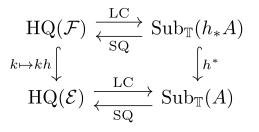
For $h$ and $A$ as in the down-sets lemma, its isomorphisms commute with $\mathrm{LC}$ and $\mathrm{SQ}$ for $(\mathcal F,h_*A)$ and $(\mathcal E,A)$:
Proof§
Describe both pairs of maps by the first lemma, with $\mathcal F=\mathcal E_h$ and $h_*A=\mathrm{LC}(h)$. For $k\le h$, the subobject $\mathrm{LC}(k)$ lies in $\mathcal E_k\subseteq\mathcal E_h$, hence in $\mathrm{LC}(h)$, so it is also the largest subobject of $\mathrm{LC}(h)$ in $\mathcal E_k$. For $B\subseteq\mathrm{LC}(h)$ we have $B\in\mathcal E_h$, so $\mathrm{SQ}(B)\le h$ is also the least quotient below $h$ containing $B$.
Proposition 4.4 (Preservation)§☆
If $h\colon\mathcal E\to\mathcal F$ is a hyperconnected geometric morphism and $A$ is a perfect $\mathbb T$-algebra in $\mathcal E$, then $h_*A$ is a perfect $\mathbb T$-algebra in $\mathcal F$.
Proof§
By the down-sets and restriction lemmas, the Galois connection of $(\mathcal F,h_*A)$ is the one of $(\mathcal E,A)$ restricted to ${\downarrow}h$ and ${\downarrow}\mathrm{LC}(h)$; here $\mathrm{LC}(h)=h^*h_*A$. If $A$ is perfect, $\mathrm{LC}$ is an order isomorphism with inverse $\mathrm{SQ}$, so it restricts to an isomorphism ${\downarrow}h\cong{\downarrow}\mathrm{LC}(h)$. Hence $h_*A$ is perfect.
Remark 4.5 (Inverse image)§
The inverse image $h^*$ of a hyperconnected geometric morphism does not preserve perfect algebras. For $\mathbb T$ the theory of groups, the trivial group is perfect in $\mathbf{Set}$. It is not perfect in $\mathbf{PSh}(\mathbb Z/2)$: this topos has two hyperconnected quotients, and the trivial group has one subgroup.
5. Related concepts§
6. References§
- [Hor] Ryuya Hora, Topoi of automata II, draft, Appendix "The Galois connection between hyperquotients and subalgebras". The public version is at ryuyahora.jp and does not contain this appendix.