 duaLab
Dedekind topos
Project: Local state classifiers
Contents
A group is a Dedekind group if every subgroup is normal, that is, if the normalizer of every subgroup is the whole group. A Dedekind topos is a topos whose Normalization operator is constant at the top element of the Local state classifier.
1. Idea§
For the right actions of a group $G$, the normalization operator $\nu$ sends a subgroup $H$ to its normalizer $N_G(H)$ (example), and the top element of $\Xi$ is the subgroup $G$. So $G$ is a Dedekind group exactly when $\nu$ is constant at the top element, and this condition makes sense in every topos with a local state classifier.
2. Definition§
The definition uses the semilattice structure of $\Xi$, whose top element is $\xi_1\colon1\to\Xi$ (proposition).
Definition 2.1 (Dedekind topos)§
Let $\mathcal E$ be a topos with Local state classifier $\Xi$ and normalization operator $\nu=\xi_\Xi\colon\Xi\to\Xi$. Then $\mathcal E$ is a Dedekind topos if $\nu=\top$, the top element of the semilattice $\mathcal E(\Xi,\Xi)$. Equivalently, $\nu$ factors through the top element $\xi_1\colon 1\rightarrowtail\Xi$ of $\Xi$.
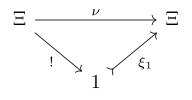
See Problem 1.2.3 of [Hor] and Remark 4.7.
3. Examples§
The first examples are the Dedekind groups, which are classified.
Example 3.1 (Groups)§
For a group $G$, the topos $\mathbf{PSh}(G)$ of right $G$-sets is Dedekind if and only if $G$ is a Dedekind group. For example, $\mathbf{PSh}(Q_8)$ for the quaternion group $Q_8$ is Dedekind.
See Remark 4.7.
Fact 3.2 (Dedekind–Baer theorem [Ded97, Bae33])§
The Dedekind groups are the abelian groups and the groups $Q_8\times(\mathbb Z/2)^{(I)}\times A$, for a direct sum $(\mathbb Z/2)^{(I)}$ of copies of $\mathbb Z/2$ and an abelian group $A$ all of whose elements have odd order.
Example 3.3 (Localic topoi)§
Every localic topos is Dedekind.
See Remark 4.7.
4. Properties§
We first ask for which monoids $M$ the topos $\mathbf{PSh}(M)$ of right $M$-sets is Dedekind. Then we compare Dedekind topoi with localic topoi.
Proposition 4.1 (Monoids)§☆
For a monoid $M$, the topos $\mathbf{PSh}(M)$ is Dedekind if and only if $M$ is a Dedekind group.
Proof§
The Local state classifier $\Xi$ of $\mathbf{PSh}(M)$ is the set of right congruences on $M$, with action $x\,(\theta\cdot a)\,y\iff ax\,\theta\,ay$, and $\top$ is the total congruence. So $\mathbf{PSh}(M)$ is Dedekind if and only if $\theta\cdot a=\theta$ for all $\theta$ and $a$.
Assume this and let $a\in M$. Let $\theta$ be the relation that identifies exactly the elements of $aM$: $x\,\theta\,y\iff x=y$ or $x,y\in aM$. It is a right congruence, since $aM$ is a right ideal: $x\in aM$ implies $xm\in aM$. Since $a\cdot 1=a$ and $a\cdot a=a^2$ lie in $aM$, we have $a\,\theta\,a^2$, that is, $1\,(\theta\cdot a)\,a$. Hence $1\,\theta\,a$, so $1=a$ or $1\in aM$; in both cases $1\in aM$. Thus every element has a right inverse, and $M$ is a group.
For a group, right congruences correspond to subgroups and the action to conjugation, so the condition says that every subgroup is normal (Remark 4.7).
Remark 4.2 (Problem 1.2.3)§
The proposition answers Problem 1.2.3 of [Hor].
Proposition 4.3 (Localic topoi)§☆
A Grothendieck topos is localic if and only if $\nu=\operatorname{id}_\Xi$ and $\nu=\top$.
See Remark 4.7.
Proof§
A Grothendieck topos is localic exactly when $\Xi\cong1$ (Corollary 5.5), and then both equations hold, as $\mathcal E(\Xi,\Xi)$ has one element. Conversely, the top of $\mathcal E(\Xi,\Xi)$ is $\xi_1{!_\Xi}$, so the two equations give $\operatorname{id}_\Xi=\xi_1{!_\Xi}$. Since also ${!_\Xi}\xi_1=\operatorname{id}_1$, the map $\xi_1$ is an isomorphism $1\cong\Xi$.
5. Related concepts§
6. References§
- [Hor25] Ryuya Hora, Normalization of a subgroup, in a topos, and of a word-congruence, arXiv:2511.05012v1, Remark 4.7.
- [Hor] Ryuya Hora, list of research problems on his former homepage, Problem 1.2.3.
- [Ded97] Richard Dedekind, Ueber Gruppen, deren sämmtliche Theiler Normaltheiler sind, Mathematische Annalen 48 (1897), 548–561.
- [Bae33] Reinhold Baer, Situation der Untergruppen und Struktur der Gruppe, Sitzungsberichte der Heidelberger Akademie der Wissenschaften (1933).