 duaLab
Bypass law
Project: Games as recursive coalgebras
Contents
The bypass law is one equation on a Rota-Baxter rig that turns game evaluation into the Grundy number: it yields both the mex and the nim-sum.
1. Idea§
In combinatorial game theory, a move $G\to H$ is reversible when the opponent can answer with a move $H\to K$ to a position $K$ of the same value as $G$. Such a move can be bypassed: replacing it by moves to all options of $K$ does not change the value of $G$. Repeated bypassing, together with merging equal options, reduces every impartial game to a single Nim heap [Con76, Ch. 10, 11].
The smallest case has $K$ the empty game. Let $G$ have a single option $H$, and let $H$ have the empty game as one of its options. Then $G$ is a second-player win, and bypassing $G\to H$ leaves no moves at all.
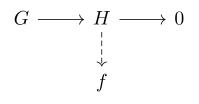
In game evaluation, $H$ has the value $\int(1+f)$, where $1=\int 0$ is the value of the empty game and $f$ collects the other options. So this bypass is the equation $\int\int(1+f)=1$. Imposed on all Rota-Baxter rigs, this single equation yields both the mex and the nim-sum: game evaluation becomes the Grundy number. Analysis behaves the opposite way: the integral of a calculus remembers plays, and no non-trivial calculus rig satisfies the bypass law.
2. Definition§
Definition 2.1 (Bypass law)§
A Rota-Baxter rig $A$ satisfies the bypass law if
In words: integrating $1+f$ twice gives the unit.
3. Examples§
Write $\oplus$ for the nim-sum, the binary addition without carry.
Definition 3.1 (Nim-sum rig)§
The nim-sum rig $\mathbb N[\mathbb N_\oplus]$ is the monoid rig of the monoid $(\mathbb N,\oplus,0)$, with basis $e_n$ $(n\in\mathbb N)$ and $e_me_n=e_{m\oplus n}$, with the integral
Example 3.2 (Grundy rig)§
The Grundy rig satisfies the bypass law. For a finite set $S$ of natural numbers, $\int(\{0\}\cup S)=\{m\}$ with $m=\mathrm{mex}(\{0\}\cup S)\geq 1$, and $\int\{m\}=\{\mathrm{mex}\{m\}\}=\{0\}$.
Example 3.3 (Smooth functions)§
In the smooth functions,
Here $x$ counts the play $G\to H$, $\frac{x^2}{2}$ the play $G\to H\to 0$, and the last term the plays through the other options of $H$. The bypass law erases all of them.
4. Properties§
The values of games satisfy the hypotheses of Products of Laguerre values under the bypass law. We write $e_n$ for the Laguerre values, the values of Nim heaps.
Lemma 4.1 (Values are involutions)§☆
In a Rota-Baxter rig satisfying the bypass law, every value $t$ of a pointed game satisfies $t^2=1$.
Proof§
Induction on the game. Write $t=\int h$, where $h=t_1+\dots+t_k$ is the sum of the values of the options, so $t_i^2=1$ by induction. By the binary equation and commutativity,
where $t_i=\int h_i$. The sum $t_ih$ contains $t_i^2=1$, so each $t_it$ has the form $\int(1+g)$. By the bypass law and the lemma on sums of units, $t^2=1$.
Lemma 4.2 (Mex)§☆
In a Rota-Baxter rig satisfying the bypass law, for all $n_1,\dots,n_k\in\mathbb N$, repetitions allowed,
where $m=\mathrm{mex}\{n_1,\dots,n_k\}$. Moreover $e_ae_b=e_{a\oplus b}$ for all $a,b\in\mathbb N$.
Proof§
The second claim is Products of Laguerre values, applied in the commutative rig of values, where $e_{2^k}^2=1$ by the lemma on involutions. For the first, put $f=\sum_ie_{n_i}$ and $t=\int f$. By the binary equation,
Each $e_{m\oplus n_i}$ has index $m\oplus n_i\geq1$, so it has the form $\int(1+g)$. For $j<m$ some $n_i$ equals $j$, so $e_jt=\int(\cdots+e_jf)$ with $e_jf$ containing $e_j^2=1$. By the bypass law and the lemma on sums of units, $e_mt=1$, so
Lemma 4.3 (The nim-sum rig)§☆
The nim-sum rig is a Rota-Baxter rig satisfying the bypass law.
Proof§
The integral of an element with support $S$ is $e_{\mathrm{mex}\,S}$; in particular $\int 0=e_0=1$. Coefficients in $\mathbb N$ do not cancel, so for supports $S$ of $f$ and $T$ of $g$ the support of $f\int g+(\int f)g$ is $(S\oplus\mathrm{mex}\,T)\cup(\mathrm{mex}\,S\oplus T)$. The binary equation is thus the identity of the mex and the nim-sum in the Idea of Rota-Baxter rig. The bypass law holds as in the Grundy rig.
Proposition 4.4 (Initial object)§☆
The nim-sum rig is initial among Rota-Baxter rigs satisfying the bypass law.
Proof§
By the previous lemma it is such a rig. For another one $A$, the map $e_n\mapsto e_n$ is a morphism of Rota-Baxter rigs, a rig morphism commuting with the integrals, by the lemma on the mex. It is the only one, because a morphism preserves the Laguerre values and they span the nim-sum rig.
Corollary 4.5 (Grundy rig)§☆
The Grundy rig is initial among Rota-Baxter rigs with idempotent addition satisfying the bypass law.
Proof§
The Grundy rig is the quotient of the nim-sum rig by $f+f=f$, which sends each element to its support; this map preserves $+$, $\cdot$ and $\int$. A morphism from the nim-sum rig to a rig with idempotent addition factors uniquely through this quotient.
Corollary 4.6 (Values are Grundy numbers)§☆
In a Rota-Baxter rig satisfying the bypass law, a finite pointed game has the value $e_g$, with $g$ its Grundy number. So two pointed games have equal values in all such rigs if and only if their Grundy numbers are equal.
Proof§
The first claim follows from the lemma on the mex by induction on the game. For the second, the values $e_g$ in the nim-sum rig are distinct.
Remark 4.7 (The mex is bypassing)§
The lemma on the mex is the reduction of impartial games to Nim heaps [Con76, Ch. 11]. In the game $G$ with options $*n_1,\dots,*n_k$, each option $*a$ with $a>m$ is reversible through $*m$, which has the value of $G$. The bypass law only bypasses through the empty game. The proof reaches $*m$ by the Conway addition of $*m$: $G=*m$ if and only if $G+*m$ has the value of the empty game, the equation $e_mt=1$.
Proposition 4.8 (Calculus rigs violate the bypass law)§☆
A calculus rig satisfying the bypass law is the zero rig.
Proof§
Applying $\partial$ twice to $\int\int 1=1$ gives $1=\partial\partial\int\int 1=\partial\partial 1=0$, and then $a=a\cdot1=a\cdot0=0$ for every $a$.
5. Related concepts§
- Rota-Baxter rig · Laguerre values · Initial Rota-Baxter rig · Calculus in characteristic 2
- Forum discussion where the bypass law was found
6. References§
- [Con76] John H. Conway, On Numbers and Games, Academic Press, 1976, Chapters 10 and 11.