 duaLab
Initial Rota-Baxter rig
Project: Games as recursive coalgebras
Contents
The tree of all plays of a position determines its value in every Rota-Baxter rig. The same tree can be evaluated in the Grundy rig to get the singleton containing the Grundy number, or in smooth functions to count plays of each length.
1. Idea§
Game evaluation in different Rota-Baxter rigs retains different information: the Grundy rig keeps the Grundy number, and the smooth functions count the plays. The most informative Rota-Baxter rig is the initial one [HS].
Each option contributes one subtree below the root. For example, consider $\int\big(\int 0+\int\int 0\big)$. Such an expression is a rooted tree: every integral sign is a vertex, and the terms under it are its children.
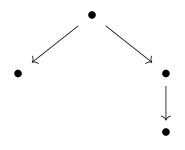
This is the tree of $\int\big(\int 0+\int\int 0\big)$. It is also the tree of plays of the Nim heap with two stones: one may take both stones, or take one and leave one. Its Grundy number is $2$. Its play counts are $1,2,1$: one empty play, two possible first moves, and one play of length two.
2. Trees§
We define the two operations on trees that become the integral and the derivative, and then the product.
Definition 2.1 (Tree)§
A tree is a finite rooted tree up to isomorphism: the children of a vertex are not ordered, and two children may carry the same subtree. We write $\mathbb T$ for the set of trees and $\mathbb N[\mathbb T]$ for the set of finite formal sums of trees with coefficients in $\mathbb N$.
Definition 2.2 (Derivative and integral of trees)§
The derivative $\partial t\in\mathbb N[\mathbb T]$ of a tree $t$ is the sum of the subtrees at the children of its root; we extend $\partial$ additively to $\mathbb N[\mathbb T]$. The integral $\int f\in\mathbb T$ of $f\in\mathbb N[\mathbb T]$ is the tree whose root has one child for each summand of $f$, carrying that summand. So
In words, $\partial$ removes the root, and $\int$ joins trees under a new root. The tree $1=\int 0$ has one vertex.
Definition 2.3 (Conway sum of trees)§
The Conway sum is the bilinear operation on $\mathbb N[\mathbb T]$ defined on trees $s$ and $t$, by recursion on the number of vertices, by
In words, a move in $s\cdot t$ is a move in $s$ or a move in $t$, as in the Conway addition of games.
Example 2.4 (A square)§
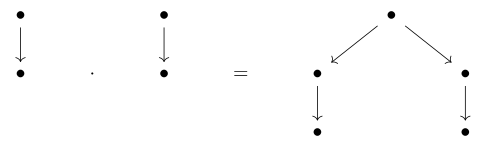
Let $x=\int 1$ be the tree with two vertices. Then $x\cdot x=\int(1\cdot x+x\cdot 1)=\int(x+x)$: its root has two children, each carrying $x$.
3. Universal property§
Trees form a Rota-Baxter rig, and every Rota-Baxter rig receives exactly one morphism from it.
Proposition 3.1 (Initial Rota-Baxter rig)§☆
With the formal sum, the Conway sum and the map $\int$, the set $\mathbb N[\mathbb T]$ is a Rota-Baxter rig, and with $\partial$ a calculus rig. It is initial: for every Rota-Baxter rig $A$ there is exactly one map $\varphi:\mathbb N[\mathbb T]\to A$ that preserves $0$, $1$, sums, products and integrals. For a calculus rig $A$, it also preserves $\partial$.
Proof§
A path in the product interleaves a path in each factor, preserving the order of their moves. With three factors, either bracketing gives the tree of the same interleavings. Swapping the factors exchanges their moves, and the one-vertex tree contributes no move. Thus the product is associative, commutative and unital. The binary equation and the Leibniz rule are the definition of the Conway sum, because $\partial\int f=f$. A morphism $\varphi$ must satisfy $\varphi(\int f)=\int\varphi(f)$, which defines it by recursion on trees. It preserves products by the induction in the proof that game evaluation preserves products, and $\partial$ because
Definition 3.2 (Tree of plays)§
The tree of plays $T_{(X,x)}\in\mathbb T$ of a pointed game $(X,x)$ is its value in the Rota-Baxter rig $\mathbb N[\mathbb T]$:
Its vertices are the plays $x\to x_1\to\cdots\to x_n$ that start at $x$, and the children of a play are its extensions by one move.
Corollary 3.3 (Most informative invariant)§☆
Let $A$ be a Rota-Baxter rig and $\varphi:\mathbb N[\mathbb T]\to A$ the unique morphism. For every pointed game $(X,x)$, the value of $(X,x)$ in $A$ is $\varphi(T_{(X,x)})$.
Proof§
Both sides satisfy the recursion that defines the value in $A$, because $\varphi$ preserves sums and integrals.
4. Related concepts§
5. References§
- [HS] Ryuya Hora and Ryo Suzuki, Differential calculus of games, unpublished draft.