 duaLab
Topoi of automata
Contents
This series aims to unify phenomena in automata theory through topos theory and to bring geometric methods into automata theory. The starting point is the observation that automata themselves form a Grothendieck topos.
1. Idea§
Fix a finite alphabet $\Sigma$. A $\Sigma$-set is a set of states with one transition for each letter, and an automaton is a $\Sigma$-set with a set of accepting states. The $\Sigma$-sets form a presheaf topos $\Sigma\text{-}\mathbf{Set}$. The orbit-finite $\Sigma$-sets, in which every state reaches only finitely many states, form a second topos $\mathcal E_{\mathrm{of}}$. There are two geometric morphisms: the point $p:\mathbf{Set}\to\Sigma\text{-}\mathbf{Set}$, whose inverse image forgets the transitions, and the hyperconnected morphism $h:\Sigma\text{-}\mathbf{Set}\to\mathcal E_{\mathrm{of}}$, whose inverse image is the inclusion of $\mathcal E_{\mathrm{of}}$.
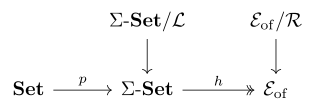
Languages come from the point. The direct image $\mathcal L=p_*\{\top,\bot\}$ of the set of two truth values is the $\Sigma$-set of all languages, and $\mathcal R=(hp)_*\{\top,\bot\}$ is the $\Sigma$-set of regular languages. The automata form the slice topos over $\mathcal L$, and the orbit-finite automata form the slice topos over $\mathcal R$. The four topoi of automata of Part I are $\Sigma\text{-}\mathbf{Set}$, $\mathcal E_{\mathrm{of}}$ and these two slices.
Classical notions as topos-theoretic ones§
Notions of automata theory are then read in these topoi as follows.
2. Results§
- Part I: the four topoi of automata, and four presentations of the Boolean-ringed topos of regular languages $(\mathcal E_{\mathrm{of}},\mathcal R)$, by the Myhill–Nerode theorem, by DFA (the Sheaf of DFA), by finite monoids and by profinite words.
- Part II: recognition of languages by monoids extends to recognition by hyperconnected geometric morphisms, and the syntactic monoid extends to the Syntactic topos. Hyperconnected quotients of $\Sigma\text{-}\mathbf{Set}$ and quotient-stable language classes are related by a Galois connection. The Local state classifier of $\Sigma\text{-}\mathbf{Set}$ consists of the right congruences on $\Sigma^*$.
- Part III: the points of $\Sigma\text{-}\mathbf{Set}$ are described by trees labelled by $\Sigma$; see Theorem 1.12.
3. Open questions§
Question 3.1 (Infinite words)§
How do geometric morphisms from the Cantor space to topoi of automata describe recognition of infinite words? One such morphism is the canonical geometric morphism from the Cantor space.
Question 3.2 (Cohomology)§
What is the cohomology of topoi of automata, and what does it say about languages? See Cohomology of language classes.
4. Pages§
5. Related concepts§
6. References§
- [Hor24] Ryuya Hora, Topoi of automata I: Four topoi of automata and regular languages, arXiv:2411.06358.
- [Hora] Ryuya Hora, Topoi of automata II: Hyperconnected geometric morphisms and syntactic topoi, prepreprint (abridged).
- [Horb] Ryuya Hora, Topoi of automata III: Geometry of $\Sigma$-Set, prepreprint.