 duaLab
Semiring of productive weak topologies
Project: Lawvere's open problems
Contents
A productive weak Lawvere–Tierney topology is a map $\Omega\to\Omega$ that preserves finite meets; it need not be idempotent, as a Lawvere–Tierney topology is. These maps form an additively idempotent semiring under meet and composition. The semiring contains the subtopoi of the topos as its multiplicative idempotents, and it acts on the hyperconnected quotients of the topos.
1. Idea§
A subtopos of a topos $\mathcal E$ corresponds to a Lawvere–Tierney topology, which is an idempotent meet-semilattice homomorphism $j:\Omega\to\Omega$. If $\mathcal E$ has a Local state classifier $\Xi$, a hyperconnected quotient of $\mathcal E$ corresponds to a meet-semilattice homomorphism $h:\Xi\to\Omega$. The composite $j\circ h$ is again such a homomorphism. So a subtopos and a hyperconnected quotient give a new hyperconnected quotient.
The composite does not use that $j$ is idempotent: every meet-semilattice homomorphism $r:\Omega\to\Omega$ acts in the same way.
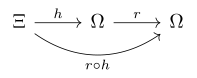
These maps can be composed, and added by the pointwise meet. So they form a semiring $\mathcal R_{\mathcal E}$, and the hyperconnected quotients form a module over it.
2. Definition§
Lawvere–Tierney topologies are not closed under composition, because a composite of two of them need not be idempotent [KM21]. A productive operator is a Lawvere–Tierney topology without the idempotence.
Definition 2.1 (Productive operator [KM21])§
Let $\top:1\to\Omega$ and $\wedge:\Omega\times\Omega\to\Omega$ be the top element and the meet of the subobject classifier of a topos $\mathcal E$. A productive weak Lawvere–Tierney topology, or productive operator, on $\mathcal E$ is an internal meet-semilattice homomorphism $r:\Omega\to\Omega$, that is, a map with
We write $\mathcal R_{\mathcal E}$ for the collection of productive operators.
See Khanjanzadeh–Madanshekaf, §2 and Definition 1.1 in Hora, The semiring of productive weak topologies.
Remark 2.2 (History)§
Productive closure operators go back to Dikranjan–Tholen, and weak Lawvere–Tierney topologies to Hosseini–Mousavi.
3. Examples§
We give the semiring for two topoi.
Example 3.1 (Sets)§
For the topos $\mathbf{Set}$, the subobject classifier is $\{\bot,\top\}$, and a productive operator sends $\top$ to $\top$. So there are two productive operators, the constant map $\top$ and the identity. They are the $0$ and the $1$ of $\mathcal R_{\mathbf{Set}}$, which is the semiring $\{0,1\}$ with $1+1=1$.
See Example 1.4 in Hora, The semiring of productive weak topologies.
Example 3.2 (Discrete dynamical systems)§
For the topos $\mathbf{PSh}(\mathbb N)$ of discrete dynamical systems, $\mathcal R_{\mathcal E}$ is the min-plus algebra on $\{0<1<\cdots<\infty<\infty'\}$: its sum is $\min$ and its product is $+$.
See Example 1.5 in Hora, The semiring of productive weak topologies.
4. Properties§
The productive operators form a semiring. Its multiplicative idempotents are the subtopoi, and it acts on the hyperconnected quotients.
Fact 4.1 (Semiring)§
With the pointwise meet $\wedge$ as addition and composition $\circ$ as multiplication, $\mathcal R_{\mathcal E}$ is an additively idempotent, possibly non-commutative semiring.
See Khanjanzadeh–Madanshekaf, Theorem 4.1 (i), recorded as Theorem 1.2 in Hora, The semiring of productive weak topologies.
Remark 4.2 (Commutative monoids)§
The endomorphisms of every commutative monoid form a semiring in the same way, with the pointwise operation as sum and the composition as product. The semiring $\mathcal R_{\mathcal E}$ is the case of the internal commutative monoid $(\Omega,\wedge,\top)$.
See Remark 1.3 in Hora, The semiring of productive weak topologies.
Fact 4.3 (Subtopoi)§
The multiplicatively idempotent elements of $\mathcal R_{\mathcal E}$ are exactly the Lawvere–Tierney topologies. Hence they correspond to the subtopoi of $\mathcal E$, and $\mathcal R_{\mathcal E}$ determines the poset of subtopoi.
See Khanjanzadeh–Madanshekaf, Remark 2.4, Johnstone, Sketches of an Elephant, A4.4.8, and Proposition 1.6 in Hora, The semiring of productive weak topologies.
Action on hyperconnected quotients§
Let $\mathcal E$ be a topos with a local state classifier $\Xi$. Then the hyperconnected quotients correspond to homomorphisms $\Xi\to\Omega$, and a productive operator acts on them by composition. We first show that, for every object $X$, the maps $X\to\Omega$ form a module over $\mathcal R_{\mathcal E}$. The case $X=\Xi$ gives the module of hyperconnected quotients.
Definition 4.4 (Action on hyperconnected quotients)§
Let $\mathcal E$ be a topos with a Local state classifier $\Xi$, with cocone maps $\xi_X:X\to\Xi$. The hyperconnected quotients of $\mathcal E$ correspond to the internal meet-semilattice homomorphisms $h:\Xi\to\Omega$ (Theorem), and a productive operator $r$ acts on them by $h\mapsto r\circ h$. We write $\mathcal{HQ}$ for the collection of hyperconnected quotients of $\mathcal E$.
Lemma 4.5 (Maps into the subobject classifier)§☆
For every object $X$ of a topos $\mathcal E$, the set $\mathcal E(X,\Omega)$ is a meet-semilattice under the pointwise meet $\varphi\wedge\psi=\wedge\circ\langle\varphi,\psi\rangle$, and a left $\mathcal R_{\mathcal E}$-module under $r\cdot\varphi=r\circ\varphi$. If $X$ is an internal meet-semilattice, its homomorphisms to $\Omega$ form a submodule.
Proof§
Write $r\varphi$ for $r\circ\varphi$, and $\top$ for the constant maps with value true, which are the additive units. The module axioms are
The first four hold by the definitions of composition and of pointwise meets, the last two because $r$ preserves $\wedge$ and $\top$. Since $\wedge:\Omega\times\Omega\to\Omega$ and $r$ are homomorphisms, $\top$, $\varphi\wedge\psi$ and $r\varphi$ are homomorphisms whenever $\varphi$ and $\psi$ are.
Proposition 4.6 (Module of hyperconnected quotients)§☆
Let $\mathcal E$ be a topos with a Local state classifier $\Xi$. Then the hyperconnected quotients of $\mathcal E$ form a meet-semilattice $\mathcal{HQ}$, and $\mathcal{HQ}$ is a left $\mathcal R_{\mathcal E}$-module.
See Theorem 2.2 in Hora, The semiring of productive weak topologies.
Proof§
By Theorem 4.1 of [Hor24], hyperconnected quotients correspond bijectively to internal meet-semilattice homomorphisms $h:\Xi\to\Omega$, which form an $\mathcal R_{\mathcal E}$-module by the lemma. The quotient of $h$ consists of the objects $X$ with $h\xi_X=\top$ (Lemma 4.3 and Proposition 4.4). So $X$ lies in the quotient of $h\wedge k$ exactly when it lies in both quotients: the meet of $\mathcal{HQ}$ is intersection, and its top element is $\mathcal E$.
Remark 4.7 (Subtopoi act on quotients)§
In particular, a subtopos and a hyperconnected quotient give a new hyperconnected quotient.
See §6 of Hora, Internal Parameterization of Hyperconnected Quotients.
Without a local state classifier§
The action does not need a local state classifier. A hyperconnected quotient $Q$ is a coreflective subcategory closed under subobjects, so every object $X$ has a largest subobject $GX$ in $Q$, its coreflection. We describe the families of subobjects $(GX)_X$ that arise in this way, and let the productive operators act on their characteristic maps.
Definition 4.8 (Productive coherent family)§
A productive coherent family on $\mathcal E$ is a family of subobjects $S_X\subseteq X$, one for each object $X$, such that
for every monomorphism $m:X\rightarrowtail Y$ and all objects $X$ and $Y$. The first equation says that the family is compatible with subobjects, and the other two that it is compatible with finite products. We write $\chi_{S_X}:X\to\Omega$ for the characteristic map of $S_X$.
Lemma 4.9 (Coreflections form a family)§☆
Let $Q$ be a hyperconnected quotient with coreflections $GX\rightarrowtail X$. Then $S_X=GX$ is a productive coherent family, and $Q=\{X\mid GX=X\}$.
Proof§
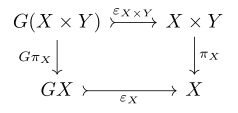
Here $G=f^*f_*$ for a hyperconnected geometric morphism $f$ whose inverse image has image $Q$. The counits $\varepsilon_X:GX\rightarrowtail X$ satisfy $m^*GY=GX$ for monos $m:X\rightarrowtail Y$, and $Q=\{X\mid GX=X\}$ (Lemma 4.3). Since $G$ preserves finite limits, $G1=1$ and $G(X\times Y)\cong GX\times GY$; the square below and its analogue for $Y$ identify $\varepsilon_{X\times Y}$ with $\varepsilon_X\times\varepsilon_Y$.
Lemma 4.10 (Monotonicity)§☆
Let $S$ be a productive coherent family. Then $S_X\subseteq f^*S_Y$ for every map $f:X\to Y$.
Proof§
Pull $S_{X\times Y}=S_X\times S_Y$ back along the graph $\langle1,f\rangle:X\rightarrowtail X\times Y$, which is monic:
Lemma 4.11 (Coreflection of a family)§☆
Let $S$ be a productive coherent family and $Q=\{X\mid S_X=X\}$. Then $Q$ is closed under subobjects and finite limits in $\mathcal E$, and $S_Y\rightarrowtail Y$ is a coreflection of $Y$ into $Q$.
Proof§
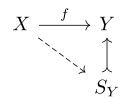
A mono $m:X\rightarrowtail Y$ gives $S_X=m^*S_Y$. So $Q$ is closed under subobjects, hence under finite limits, as $S_1=1$ and $S_{X\times Y}=S_X\times S_Y$; and $S_{S_Y}=S_Y$, that is, $S_Y\in Q$. If $X\in Q$ and $f:X\to Y$, then $X=S_X\subseteq f^*S_Y$ by the lemma, so $f$ factors uniquely through $S_Y$:
Lemma 4.12 (Quotients as coherent families)§☆
A hyperconnected quotient $Q$ with coreflections $GX\rightarrowtail X$ corresponds to the family $S_X=GX$, and $Q=\{X\mid S_X=X\}$. The families that arise are exactly the productive coherent families.
Proof§
One direction is the lemma on coreflections. Conversely, let $S$ be productive coherent and $Q=\{X\mid S_X=X\}$. By the lemma, $Y\mapsto S_Y$ is an idempotent comonad with coalgebras the objects of $Q$, preserving finite limits because $Q$ is closed under them. So $Q\hookrightarrow\mathcal E$ is the inverse image of a geometric morphism (Johnstone, Sketches of an Elephant, Corollary A4.2.2), hyperconnected because $Q$ is closed under subobjects (Proposition A4.6.6 there). Its coreflections are the $S_Y$, so the two constructions are mutually inverse.
Definition 4.13 (Action on coherent families)§
A productive operator $r$ acts on productive coherent families by composing with the characteristic maps, $\chi_{(r\cdot S)_X}=r\circ\chi_{S_X}$.
Lemma 4.14 (Operations on coherent families)§☆
Let $S$ and $S'$ be productive coherent families and $r$ a productive operator. Then $(S_X\cap S'_X)_X$ and $r\cdot S$ are productive coherent families.
Proof§
In terms of the characteristic maps $\varphi_X=\chi_{S_X}$, a family is productive coherent exactly when, for every mono $m:X\rightarrowtail Y$,
The pointwise meet $\varphi_X\wedge\varphi'_X$ classifies $S_X\cap S'_X$. The three equations are preserved by pointwise meets and by composition with $r$, because $\wedge$ and $r$ preserve $\top$ and $\wedge$.
Definition 4.15 (Action on quotients)§
Let $r$ be a productive operator and $Q$ the hyperconnected quotient of a productive coherent family $S$. We write $r\cdot Q$ for the hyperconnected quotient of the family $r\cdot S$:
Proposition 4.16 (Without a classifier)§☆
For every elementary topos $\mathcal E$, the hyperconnected quotients of $\mathcal E$ form a meet-semilattice $\mathcal{HQ}$ under intersection, and $\mathcal{HQ}$ is a left $\mathcal R_{\mathcal E}$-module.
Proof§
By the lemma on coherent families, hyperconnected quotients correspond to productive coherent families $S$, with $Q=\{X\mid S_X=X\}$. These families are closed under intersection and under the action of $\mathcal R_{\mathcal E}$ (lemma), and the module axioms hold for their characteristic maps at each $X$ (lemma). Intersections of families give intersections of quotients, because $S_X\cap S'_X=X$ if and only if $S_X=X$ and $S'_X=X$. When a local state classifier exists, $\chi_{S_X}=h\xi_X$ (Proposition 4.4), so this action is $h\mapsto r\circ h$.
Remark 4.17 (The assumption is not needed)§
So the proposition on the module holds without a local state classifier.
See the footnote to Theorem 2.2 in Hora, The semiring of productive weak topologies.
Quotients fixed by a subtopos§
Let $j$ be a Lawvere–Tierney topology and $Q$ a hyperconnected quotient. When is $j\cdot Q=Q$? The answer uses the closure of $j$: the $j$-closure $\overline A$ of a subobject $A\subseteq X$ is the subobject with characteristic map $j\circ\chi_A$, and $A$ is $j$-dense if $\overline A=X$ and $j$-closed if $\overline A=A$.
Lemma 4.18 (Action of a topology)§☆
Let $j$ be a Lawvere–Tierney topology and $Q$ a hyperconnected quotient with coreflections $GX\rightarrowtail X$. Then $X\in j\cdot Q$ if and only if $GX\rightarrowtail X$ is $j$-dense.
Proof§
By the lemma on coherent families, $j\cdot Q$ is the quotient of the family $j\cdot S$ with $S_X=GX$, so $X\in j\cdot Q$ if and only if $j\circ\chi_{GX}=\top$. Since $j\circ\chi_{GX}$ classifies the $j$-closure of $GX$ in $X$, this means that $GX\rightarrowtail X$ is $j$-dense.
Proposition 4.19 (Fixed quotients)§☆
Let $j$ be a Lawvere–Tierney topology and $Q$ a hyperconnected quotient with coreflections $GX\rightarrowtail X$. Then $j\cdot Q=Q$ if and only if every $GX\rightarrowtail X$ is $j$-closed.
Proof§
A subobject is $j$-closed if and only if $j\circ\chi=\chi$ for its characteristic map $\chi$. If every $GX\rightarrowtail X$ is $j$-closed, then $j\cdot S=S$ for the family $S_X=GX$, so $j\cdot Q=Q$. Conversely, if $j\cdot Q=Q$, then $j\cdot S=S$, because a hyperconnected quotient determines its family (lemma on coherent families); so every $GX\rightarrowtail X$ is $j$-closed.
Lemma 4.20 (Dense subobjects)§☆
Let $j$ and $Q$ be as in the proposition on fixed quotients. Then $X\in j\cdot Q$ if and only if $X$ has a $j$-dense subobject in $Q$.
Proof§
If $X\in j\cdot Q$, then $GX\in Q$ is a $j$-dense subobject of $X$ by the lemma on the action of a topology. Conversely, let $A\rightarrowtail X$ be $j$-dense with $A\in Q$. Since $GX\rightarrowtail X$ is a coreflection, $A\rightarrowtail X$ factors through it, so $A\subseteq GX$. The $j$-closure is monotone, so $X=\overline A\subseteq\overline{GX}$, and $GX$ is $j$-dense. Hence $X\in j\cdot Q$.
Corollary 4.21 (Dense extensions)§☆
Let $j$ and $Q$ be as in the proposition on fixed quotients. Then $j\cdot Q=Q$ if and only if $Q$ is closed under $j$-dense extensions.
Proof§
Every $X\in Q$ is a $j$-dense subobject of itself, so $Q\subseteq j\cdot Q$ by the lemma on dense subobjects. By the same lemma, $j\cdot Q\subseteq Q$ means exactly that every object with a $j$-dense subobject in $Q$ lies in $Q$.
Definition 4.22 (Closed topology)§
Let $U$ be a subterminal object of $\mathcal E$ with characteristic map $u:1\to\Omega$. The closed topology $c(U)$ is the Lawvere–Tierney topology $p\mapsto p\vee u$. Its subtopos is the closed subtopos complementary to $U$.
Lemma 4.23 (Closed topologies)§☆
Let $Q$ be a hyperconnected quotient with coreflections $GX\rightarrowtail X$, and let $U$ be a subterminal. Then $c(U)\cdot Q=Q$ if and only if $X\times U\subseteq GX$ for every $X$.
Proof§
Let $X\times U\rightarrowtail X$ be the pullback of $U\rightarrowtail 1$. The $c(U)$-closure of a subobject $A\rightarrowtail X$ is $A\cup(X\times U)$. Hence $GX$ is $c(U)$-closed exactly when $X\times U\subseteq GX$; apply the proposition on fixed quotients.
Corollary 4.24 (Closed subtopoi)§☆
For a hyperconnected quotient $Q$ and the closed subtopos $c(U)$ of a subterminal $U$, $c(U)\cdot Q=Q$ if and only if every object with a map to $U$ lies in $Q$.
Proof§
By the lemma, $c(U)\cdot Q=Q$ means that $X\times U\subseteq GX$ for every $X$. If every object with a map to $U$ lies in $Q$, then $X\times U\in Q$, so $X\times U\rightarrowtail X$ factors through the coreflection $GX$. Conversely, if $Y$ has a map to $U$, then $Y\times U=Y$ because $U$ is subterminal, so $Y\subseteq GY$ and $Y\in Q$.
Remark 4.25 (Pierce spectrum)§
The semiring $\mathcal R_{\mathcal E}$ with its module $\mathcal{HQ}$ looks like a non-commutative, semilattice version of the Pierce spectrum. From this point of view, the module $\mathcal{HQ}$ is a kind of quasi-coherent sheaf.
See Remark 2.5 in Hora, The semiring of productive weak topologies.
5. Related concepts§
6. References§
- [Hor] Ryuya Hora, The semiring of productive weak topologies, unpublished note. The same material appears in the section "Module structure of subtopoi and hyperconnected quotients" of his unpublished notes More on LSC.
- [Hor24] Ryuya Hora, Internal Parameterization of Hyperconnected Quotients, Theory and Applications of Categories 42 (2024), no. 11, 263–313, §6.
- [KM21] Zeinab Khanjanzadeh and Ali Madanshekaf, Weak topologies on toposes, Bulletin of the Iranian Mathematical Society 47 (2021), no. 2, 461–486.
- [DT95] Dikran Dikranjan and Walter Tholen, Categorical Structure of Closure Operators, Kluwer, 1995.
- [HM06] S. N. Hosseini and S. Sh. Mousavi, A relation between closure operators on a small category and its category of presheaves, Applied Categorical Structures 14 (2006), no. 2, 99–110.
- [Law09] F. William Lawvere, Open problems in topos theory, April 2009, problem 2. Available via The Lawvere Archives.