 duaLab
Monoidal game sum
Project: Games as recursive coalgebras
Contents
A monoidal game sum is a way of playing two games at once that makes the category of games symmetric monoidal, with the pairs of positions as the positions of the sum. The Conway addition is the best-known one. Unlike for graphs, there are infinitely many monoidal game sums, and together they form a compact moduli space.
1. Idea§
A sum of games is a tool to decompose a complicated game into simpler ones [Hor25, §4.1]. For every such sum and every game value $v$ there is a Bouton monoid: a game value $b$ with values in a monoid, minimal with the properties that $v$ is a function of $b$ and that the value $b(x,y)$ at a position of a sum is the product of $b(x)$ and $b(y)$. For the Conway addition and the outcome, it is the Grundy number with the nim-sum. So every sum of games gives one such rule, and we would like to know all sums [Hor25, §5.3].
In the sums considered below, a position of the sum of $X$ and $Y$ is a pair $(x,y)$ of positions. The sums differ in the options of $(x,y)$; see the classical sums.
2. Definition§
The following definition is the most restrictive one in [Hor25, §5.3], and Question 5.5 there asks to classify these structures.
Definition 2.1 (Monoidal game sum)§
A monoidal game sum is a symmetric monoidal closed structure $\otimes$ on Games for which the forgetful functor $U:\mathbf{Games}\to\mathbf{Set}$ is strict monoidal for the cartesian product of sets. So $X\otimes Y$ is a game on the set $U(X)\times U(Y)$ of pairs of positions, the sum of two game morphisms $f$ and $g$ is the map $(x,y)\mapsto(f(x),g(y))$, and the associativity and unit isomorphisms are those of pairs. What a monoidal game sum chooses is the set of options of every pair $(x,y)$.
3. Examples§
The three classical sums of games are monoidal game sums. A position is terminal if it has no option.
Example 3.1 (Classical sums)§
Let $x'$ range over the options of $x$, and $y'$ over the options of $y$. Each of the following three rules for the options of $(x,y)$ defines a monoidal game sum.
In words: one component moves; a non-empty set of components moves; every non-terminal component moves.
See Hor25, Proposition 4.2 and Example 4.3 for the first two sums and Con76, Chapter 14 for the three sums.
Example 3.2 (Two heaps with one stone)§
Let $X$ be the Nim heap with one stone: its positions are $1$ and $0$, and its only move is $1\to0$. The three classical sums of $X$ with itself are, from left to right, the Conway addition, the selective sum and the continued conjunctive sum.
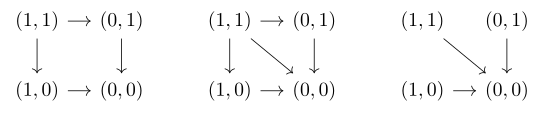
They differ only in the options of $(1,1)$, the pair without a terminal position; compare the proposition on terminal positions.
4. Properties§
Much of a monoidal game sum is forced. For every monoidal game sum $\otimes$, the unit, the symmetry and the options of a pair with a terminal position are the same, and $\otimes$ is determined by the sums of finite games.
Lemma 4.1 (Natural endomorphisms)§☆
Every natural transformation $\gamma\colon U\to U$ of the forgetful functor $U:\mathbf{Games}\to\mathbf{Set}$ is the identity.
Proof§
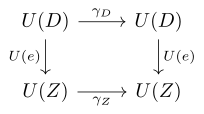
Let $z$ be a position of a game $Z$. Let $D$ be the game of finite sequences $((z^1,b_1),\dots,(z^m,b_m))$ with $z\to z^1\to\dots\to z^m$ moves of $Z$ and $b_k\in\{0,1\}$, whose options are the one-step extensions. Flipping the bits at a fixed depth is an automorphism of $D$, so the empty sequence $r$ is the only position fixed by all automorphisms. By naturality $\gamma_D(r)$ is fixed by them, hence equals $r$. Sending a sequence to its last position $z^m$, and $r$ to $z$, is a game morphism $e\colon D\to Z$. The naturality square below gives $\gamma_Z(z)=e(\gamma_D(r))=e(r)=z$.
Lemma 4.2 (Natural maps are projections)§☆
Every natural transformation $\beta\colon U(X_1)\times\dots\times U(X_n)\to U(X_i)$, natural in the games $X_1,\dots,X_n$, is the $i$-th projection.
Proof§
Fix the games $X_j$ and positions $x_j\in X_j$ for $j\neq i$. Then the maps $z\mapsto\beta(x_1,\dots,z,\dots,x_n)$, with $z$ in the $i$-th place, form a natural transformation $U\to U$. It is the identity by the lemma.
Proposition 4.3 (Forced structure)§☆
The unit of $\otimes$ is the one-position game, and its symmetry is the swap $(x,y)\mapsto(y,x)$. Closedness is automatic: every symmetric monoidal structure on Games for which $U$ is strict monoidal is closed.
Proof§
The unit has one position since $U$ is strict monoidal, and a one-position game has no move, since a loop would be an infinite play. The two components of the symmetry are natural maps $U(X)\times U(Y)\to U(Y)$ and $U(X)\times U(Y)\to U(X)$, hence projections by the lemma. Closedness is Corollary B.11 of [Hor25].
Proposition 4.4 (Terminal positions)§☆
If $y\in Y$ is terminal, the options of $(x,y)$ in $X\otimes Y$ are the pairs $(x',y)$ with $x'$ an option of $x$.
Proof§
The map $y\colon 1\to Y$ from the one-position game is a game morphism because $y$ is terminal. So $X\cong X\otimes 1\to X\otimes Y$ is a game morphism, and its underlying function is $x\mapsto(x,y)$ since $U$ is strict monoidal. Game morphisms preserve the set of options.
Corollary 4.5 (Terminal pairs)§☆
A position $(x,y)$ of $X\otimes Y$ is terminal if and only if $x$ and $y$ are terminal.
Proof§
If $x$ or $y$ is terminal, this is the proposition and its mirror image under the symmetry. Suppose $x$ and $y$ are not terminal but $(x,y)$ is; then $(y,x)$ is terminal in $Y\otimes X$. By the proposition, the options of $((x,y),x)$ are the $((x,y),x')$ and those of $(x,(y,x))$ are the $(x',(y,x))$, for options $x'$ of $x$. The associator identifies these two non-empty sets, so $x'=x$ for some option $x'$ of $x$, an infinite play.
Proposition 4.6 (Finite games suffice)§☆
Every option of $(x,y)$ in $X\otimes Y$ is a pair $(x',y')$ with $x'$ reachable from $x$ and $y'$ reachable from $y$ in zero or more moves. Hence $\otimes$ is determined by the games $A\otimes B$ for finite games $A$ and $B$.
Proof§
Let $A\subseteq X$ and $B\subseteq Y$ be the subgames of positions reachable from $x$ and from $y$; they are finite. The inclusions are game morphisms, so $A\otimes B\to X\otimes Y$ is a game morphism whose underlying function is the inclusion of $A\times B$. Hence the options of $(x,y)$ in $X\otimes Y$ are its options in $A\otimes B$.
Proposition 4.7 (Comonad form)§☆
Let $R$ be the right adjoint of $U$, the cofree game functor, and let $G=UR$ be the comonad of cofree games on $\mathbf{Set}$. Monoidal game sums correspond bijectively to the structures of a symmetric lax monoidal functor on $G$, with maps $m_{S,T}\colon G(S)\times G(T)\to G(S\times T)$, for which the counit and the comultiplication are monoidal.
See BV07, Theorem 2.3, a reformulation of the main result of Moe02, for the dual statement about monads, without symmetry.
Proof§
Games is the category of $G$-coalgebras, by comonadicity. From $m$, the sum of coalgebras $a\colon A\to GA$ and $b\colon B\to GB$ is
From $\otimes$, the map $m_{S,T}$ is the structure map of $RS\otimes RT$ followed by $G(\varepsilon_S\times\varepsilon_T)$, for the counit $\varepsilon$ of $G$. This is the bijection of the cited theorem, applied to the monad $G$ on $\mathbf{Set}^{\mathrm{op}}$. By the proposition the symmetry is the swap, and the swap is a game morphism $A\otimes B\to B\otimes A$ for all $A,B$ if and only if $m$ is symmetric.
5. The moduli space§
By the proposition, monoidal game sums can be compared on finite games. This gives a topology on the set of all of them: two monoidal game sums are close when they agree on many pairs of finite games.
Definition 5.1 (Moduli space of monoidal game sums)§
For finite games $A$ and $B$, let $\mathrm{Str}(A\times B)$ be the finite discrete set of game structures on the set $U(A)\times U(B)$. The moduli space of monoidal game sums $\mathcal S$ is the set of monoidal game sums, with the topology induced by the injection
in which $A$ and $B$ range over the finite games up to isomorphism.
Proposition 5.2 (Compactness)§☆
The product $\prod_{A,B}\mathrm{Str}(A\times B)$ is a Cantor space, and $\mathcal S$ is closed in it. So $\mathcal S$ is compact, metrizable and totally disconnected.
Proof§
A point of the product is a monoidal game sum on finite games if and only if it satisfies every instance of naturality, of the unit law, of symmetry and of associativity for finite games. Each instance involves finitely many coordinates, so it defines a closed-open set. Such a point extends to all games by computing the options of $(x,y)$ in the sum of the finite subgames reachable from $x$ and from $y$, as in the proposition.
Proposition 5.3 (Infinitely many)§☆
The space $\mathcal S$ is infinite, and the three classical sums are not isolated points of it.
Remark 5.4 (Graphs)§
The category of reflexive graphs carries exactly two closed symmetric monoidal structures, the box product and the categorical product [KK24]. Their formulas are those of the Conway addition and of the selective sum.
6. Open questions§
Question 6.1 (Isolated points)§
Does the moduli space of monoidal game sums $\mathcal S$ have an isolated point? It has none if and only if it is homeomorphic to the Cantor space.
7. Related concepts§
8. References§
- [Hor25] Ryuya Hora, Games as recursive coalgebras: A categorical view on the Nim-sum, arXiv:2510.22886, §4.1, §5.3, Question 5.5 and Corollary B.11.
- [Con76] John H. Conway, On Numbers and Games, Academic Press (1976), Chapter 14.
- [KK24] Krzysztof Kapulkin and Nathan Kershaw, Closed symmetric monoidal structures on the category of graphs, Theory and Applications of Categories 41 (2024), no. 23, 760–784.
- [BV07] Alain Bruguières and Alexis Virelizier, Hopf monads, Advances in Mathematics 215 (2007), 679–733, Theorem 2.3.
- [Moe02] Ieke Moerdijk, Monads on tensor categories, Journal of Pure and Applied Algebra 168 (2002), 189–208.