 duaLab
Gaeta topos
Contents
Which Grothendieck topoi have enough projectives? The answer is a characterization by sites: they are the sheaf topoi on small $\kappa$-extensive categories for some regular cardinal $\kappa$, the $\kappa$-Gaeta topoi. The case $\kappa=\aleph_0$ gives the Gaeta topoi, and the case $\kappa=2$ gives exactly the presheaf topoi.
1. Idea§
A Grothendieck topos has enough projectives if every object receives an epimorphism from a projective object. Presheaf topoi have enough projectives, and so do Gaeta topoi, the sheaf topoi on small extensive categories for the topology generated by finite coproduct decompositions. The question of which Grothendieck topoi have enough projectives was asked by Morgan Rogers on MathOverflow.
In a $\kappa$-Gaeta topos, the finite coproducts of a Gaeta topos are replaced by coproducts of fewer than $\kappa$ objects, for a regular cardinal $\kappa$ that may be finite. A Grothendieck topos has enough projectives if and only if, for some $\kappa$, it is the sheaf topos on a small $\kappa$-extensive category for its $\kappa$-extensive topology.
2. Definition§
A $\kappa$-Gaeta topos is defined by a site: a $\kappa$-extensive category, in which an object is covered by its decompositions into fewer than $\kappa$ summands.
Definition 2.1 (Regular cardinal)§
Let $\kappa$ be a cardinal, possibly finite. A set is $\kappa$-small if its cardinality is less than $\kappa$, and a family, a coproduct or a product is $\kappa$-small if its index set is. The cardinal $\kappa$ is regular if $1<\kappa$ and every $\kappa$-small coproduct of $\kappa$-small sets is $\kappa$-small. The regular cardinals begin $2,\aleph_0,\aleph_1,\dots$. See Definition 2.1 in Hora, Topos with enough projectives.
Definition 2.2 (κ-extensive category)§
A small category is $\kappa$-extensive if it has $\kappa$-small coproducts and pullbacks of $\kappa$-small coproduct inclusions along arbitrary maps, and its $\kappa$-small coproducts are disjoint and pullback-stable. In formulas, let $X=\coprod_{i\in I}X_i$ be a $\kappa$-small coproduct with inclusions $\iota_i:X_i\to X$. Then every $\iota_i$ is a monomorphism, and for $i\neq j$ and every morphism $g:Y\to X$
See Definition 2.2 in Hora, Topos with enough projectives.
Example 2.3 (Small values of κ)§
A $2$-small coproduct is an initial object or a single object. So a category is $2$-extensive if and only if it has a strict initial object. For $\kappa=\aleph_0$, the $\kappa$-small coproducts are the finite coproducts, and $\aleph_0$-extensivity is the usual extensivity studied by Carboni, Lack and Walters [CLW93]. See the list after Definition 2.2 in Hora, Topos with enough projectives.
Definition 2.4 (κ-extensive topology)§
Let $\mathcal C$ be a small $\kappa$-extensive category. A $\kappa$-small coproduct diagram is a $\kappa$-small family $\{X_i\to X\}_{i\in I}$ whose canonical map $\coprod_{i\in I}X_i\to X$ is an isomorphism. Write $J_{\kappa\text{-ext}}$ for the collection of sieves that contain a $\kappa$-small coproduct diagram. It is called the $\kappa$-extensive topology, and $(\mathcal C,J_{\kappa\text{-ext}})$ the $\kappa$-extensive site of $\mathcal C$. In words, a sieve on $X$ covers if it contains the inclusions of a decomposition of $X$ into fewer than $\kappa$ summands. For $\kappa=2$ the covering sieves are the maximal sieves and all sieves on an initial object. See Notation 2.3 and Definition 2.5 in Hora, Topos with enough projectives.
Lemma 2.5 (κ-extensive topology)§★
For a small $\kappa$-extensive category $\mathcal C$, $J_{\kappa\text{-ext}}$ is a Grothendieck topology. See Lemma 2.4 in Hora, Topos with enough projectives.
Proof§
The maximal sieve on $X$ contains the $\kappa$-small coproduct diagram $\mathrm{id}_X$, since $1<\kappa$. Stability follows from the pullback-stability of $\kappa$-small coproducts, and transitivity from the regularity of $\kappa$.
Definition 2.6 (κ-Gaeta topos)§
For a regular cardinal $\kappa$, a Grothendieck topos $\mathcal E$ is a $\kappa$-Gaeta topos if $\mathcal E\simeq\mathbf{Sh}(\mathcal C,J_{\kappa\text{-ext}})$ for some small $\kappa$-extensive category $\mathcal C$. See Definition 2.6 in Hora, Topos with enough projectives.
3. Examples§
The examples begin with the cases $\kappa=2$ and $\kappa=\aleph_0$ of the table in the Idea.
Example 3.1 (Presheaf topoi)§
The $2$-Gaeta topoi are exactly the presheaf topoi; see the corollary below.
Example 3.2 (Gaeta topoi)§
Gaeta topoi are the case $\kappa=\aleph_0$. See Figure 1 in Hora, Topos with enough projectives.
Example 3.3 (Condensed sets)§
For a strong limit cardinal $\lambda$, the topos of $\lambda$-condensed sets is equivalent to the sheaf topos over the $\aleph_0$-extensive site of $\lambda$-extremely disconnected spaces. Hence it is $\aleph_0$-Gaeta and has enough projectives. See Example 5.3 in Hora, Topos with enough projectives.
4. Properties§
We describe the sheaves on a $\kappa$-extensive site, state the characterization of the topoi with enough projectives, and then prove it.
Sheaves on a $\kappa$-extensive site§
A sheaf for the $\kappa$-extensive topology is a presheaf that sends $\kappa$-small coproducts to products. The lemmas prepare the proof, and the corollaries are its first consequences.
Lemma 4.1 (Factoring through coproduct inclusions)§☆
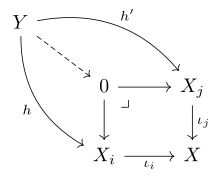
Let $\{\iota_i:X_i\to X\}_{i\in I}$ be a $\kappa$-small coproduct diagram in a $\kappa$-extensive category. The initial object $0$ is strict, and a morphism $g:Y\to X$ from a non-initial object $Y$ factors through $\iota_i$ for at most one $i\in I$, and then as $g=\iota_ih$ for a unique $h$.
Proof§
Both claims are instances of extensivity. Pulling the empty coproduct $0$ back along a morphism $Y\to0$ gives $Y\cong0$, so $0$ is strict. Each $\iota_i$ is monic, so $h$ is unique. If $g=\iota_ih=\iota_jh'$ with $i\neq j$, disjointness makes the square below a pullback, so $Y$ maps to $0$ and is initial.
Lemma 4.2 (Matching families on a coproduct sieve)§☆
Let $S$ be the sieve generated by a $\kappa$-small coproduct diagram $\{\iota_i:X_i\to X\}_{i\in I}$ in a $\kappa$-extensive category, and $T$ a presheaf with $T(0)\cong1$. Then $(t_g)_{g\in S}\mapsto(t_{\iota_i})_{i\in I}$ is a bijection from the matching families of $T$ for $S$ to $\prod_{i\in I}T(X_i)$.
Proof§
We construct the inverse. Send $(t_i)_{i\in I}$ to the family $t_{\iota_ih}=t_ih$. By the lemma, $g=\iota_ih$ determines $(i,h)$ unless the domain $Y$ of $g$ is initial, and then $T(Y)\cong1$; so $t_g$ is well defined. It is matching since $(\iota_ih)k=\iota_i(hk)$. The two maps are mutually inverse because every matching family satisfies $t_{\iota_ih}=t_{\iota_i}h$.
Lemma 4.3 (Amalgamation along a coproduct diagram)§☆
Let $T$ be a presheaf on a $\kappa$-extensive category that sends $\kappa$-small coproducts to products, $S$ a sieve on $X$ containing a $\kappa$-small coproduct diagram $\{\iota_i:X_i\to X\}_{i\in I}$, and $(t_g)_{g\in S}$ a matching family of $T$. If $t\in T(X)$ satisfies $t\iota_i=t_{\iota_i}$ for all $i\in I$, then $tg=t_g$ for all $g\in S$.
Proof§
We compare $tg$ and $t_g$ on a coproduct decomposition of the domain $Y$ of $g$. Pull the coproduct diagram back along $g$:
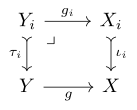
By pullback-stability $Y\cong\coprod_iY_i$, so $T(Y)\cong\prod_iT(Y_i)$, and it suffices to check
Proposition 4.4 (Sheaf condition)§☆
For a small $\kappa$-extensive category $\mathcal C$, a presheaf $T:\mathcal C^{\mathrm{op}}\to\mathbf{Set}$ is a $J_{\kappa\text{-ext}}$-sheaf if and only if it sends $\kappa$-small coproducts to products:
See Proposition 2.7 in Hora, Topos with enough projectives.
Proof§
Each direction is a lemma above. A sheaf $T$ has $T(0)\cong1$, as the empty sieve covers $0$; for the sieve $S$ generated by a $\kappa$-small coproduct diagram $\{\iota_i:X_i\to X\}_{i\in I}$, the sheaf condition and the lemma give
Conversely, let $T$ send $\kappa$-small coproducts to products and $(t_g)_{g\in S}$ be a matching family for a covering sieve $S\supseteq\{\iota_i\}_{i\in I}$. Exactly one $t\in T(X)$ has $t\iota_i=t_{\iota_i}$ for all $i$, as every amalgamation must; it is one by the lemma.
Corollary 4.5 (Subcanonicity)§★
The $\kappa$-extensive topology is subcanonical. See Corollary 2.8 in Hora, Topos with enough projectives.
Proof§
This follows immediately from the sheaf condition.
Corollary 4.6 (Presheaf topoi)§★
A Grothendieck topos is a $2$-Gaeta topos if and only if it is a presheaf topos. See Corollary 2.9 in Hora, Topos with enough projectives.
Proof§
For a small category $\mathcal C$, let $\mathcal C^{\triangleleft}$ be $\mathcal C$ with a new initial object added. Since $2$-extensivity means having a strict initial object, $\mathcal C^{\triangleleft}$ is $2$-extensive, and every $2$-extensive category is equivalent to one of this form. The sheaf condition gives $\mathbf{Sh}(\mathcal C^{\triangleleft},J_{2\text{-ext}})\simeq\mathbf{PSh}(\mathcal C)$.
Topoi with enough projectives§
We state the characterization of the topoi with enough projectives. One of its conditions is about the sites in which every covering sieve contains a covering sieve that is a coproduct of representable presheaves.
Definition 4.7 (Enough projectives)§
An object $P$ of a category $\mathcal E$ is projective if the functor $\mathcal E(P,-)$ preserves epimorphisms. The category $\mathcal E$ has enough projectives if every object $X$ has an epimorphism $P\to X$ from a projective object $P$. See Definition 4.2 in Hora, Topos with enough projectives.
Definition 4.8 (Free sieve)§
Let $\mathcal C$ be a small category and $y:\mathcal C\to\mathbf{PSh}(\mathcal C)$ its Yoneda embedding. A sieve $S$ on an object $X$ is free if, as a presheaf, it is a small coproduct of representable presheaves: $S\cong\coprod_{i\in I}y(X_i)$. In words, there are morphisms $f_i:X_i\to X$ in $S$ such that every morphism $g$ in $S$ factors as $g=f_ih$ for exactly one pair $(i,h)$. See Definition 3.1 in Hora, Topos with enough projectives.
Definition 4.9 (Generated by free sieves)§
A Grothendieck topology $J$ on a small category $\mathcal C$ is generated by free sieves if every $J$-covering sieve contains a free $J$-covering subsieve. See Definition 3.3 in Hora, Topos with enough projectives.
Example 4.10 (Trivial topology)§
The trivial topology is generated by free sieves. See Example 3.4 in Hora, Topos with enough projectives.
Proposition 4.11 (Enough projectives)§☆
For a Grothendieck topos $\mathcal E$, the following are equivalent.
- The topos $\mathcal E$ has enough projectives.
- The topos $\mathcal E$ is a $\kappa$-Gaeta topos for some regular cardinal $\kappa$.
- There is a small site $(\mathcal C,J)$ generated by free sieves with $\mathcal E\simeq\mathbf{Sh}(\mathcal C,J)$.
See Theorem 5.1 in Hora, Topos with enough projectives.
Proof§
We prove the three implications of the following diagram. They are the corollary on the canonical site, the lemma on removing initial objects, and the lemma that free sieves give projectives.

From extensive sites to projectives§
We show that a $\kappa$-Gaeta topos has a site generated by free sieves, and that the sheaf topos on such a site has enough projectives.
Lemma 4.12 (Coproduct sieves are free)§☆
Let $\{\iota_i:X_i\to X\}_{i\in I}$ be a $\kappa$-small coproduct diagram in a $\kappa$-extensive category $\mathcal C$ with $X$ and all $X_i$ non-initial, and $\mathcal C'\subseteq\mathcal C$ the full subcategory of non-initial objects. The sieve $S'$ on $X$ in $\mathcal C'$ generated by the $\iota_i$ is free: $\coprod_{i\in I}y(X_i)\cong S'$.
Proof§
By the lemma, every $g:Y\to X$ in $S'$ factors as below for exactly one pair $(i,h)$.
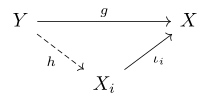
So the canonical map $\coprod_{i\in I}y(X_i)\to S'$ is bijective at every $Y\in\mathcal C'$.
Lemma 4.13 (Removing initial objects)§☆
Let $\mathcal C$ be a small $\kappa$-extensive category, and $\mathcal C'$ its full subcategory of non-initial objects. The restriction $J'$ of $J_{\kappa\text{-ext}}$ to $\mathcal C'$ is a Grothendieck topology generated by free sieves, and $\mathbf{Sh}(\mathcal C,J_{\kappa\text{-ext}})\simeq\mathbf{Sh}(\mathcal C',J')$. See Proposition 3.5 in Hora, Topos with enough projectives.
Proof§
The equivalence is the comparison lemma, and freeness is the lemma. Objects of $\mathcal C$ outside $\mathcal C'$ are initial, hence covered by the empty sieve, so $\mathcal C'$ is a dense sub-site, and the comparison lemma shows that $J'$ is a Grothendieck topology with $\mathbf{Sh}(\mathcal C,J_{\kappa\text{-ext}})\simeq\mathbf{Sh}(\mathcal C',J')$. A $J'$-covering sieve $S$ generates a sieve in $\mathcal C$ containing a $\kappa$-small coproduct diagram. Its non-initial summands form a coproduct diagram in $S$, which generates a free $J'$-covering sieve $S'\subseteq S$.
Lemma 4.14 (Pointwise epimorphisms give projectives)§☆
Let $(\mathcal C,J)$ be a small site with sheafification $\mathbf a$. If the inclusion $\mathbf{Sh}(\mathcal C,J)\hookrightarrow\mathbf{PSh}(\mathcal C)$ preserves epimorphisms, then every $\mathbf ay(X)$ is projective, and $\mathbf{Sh}(\mathcal C,J)$ has enough projectives.
Proof§
The functor $\mathbf{Sh}(\mathcal C,J)(\mathbf ay(X),-)\cong(-)(X)$ preserves epimorphisms by assumption, so $\mathbf ay(X)$ is projective. Every sheaf $F$ receives an epimorphism from $\coprod_{X,\,x\in F(X)}\mathbf ay(X)$, and a coproduct of projectives is projective.
Lemma 4.15 (Free sieves give projectives)§☆
If a site $(\mathcal C,J)$ is generated by free sieves, then the inclusion $\mathbf{Sh}(\mathcal C,J)\hookrightarrow\mathbf{PSh}(\mathcal C)$ preserves epimorphisms. Hence $\mathbf{Sh}(\mathcal C,J)$ has enough projectives. See Definition 3.6 and Proposition 3.8 in Hora, Topos with enough projectives.
Proof§
Let $f:A\to B$ be an epimorphism of sheaves and $b\in B(X)$; we find $a\in A(X)$ with $f(a)=b$. As $f$ is a local epimorphism and $J$ is generated by free sieves, there are a free covering sieve $S'\cong\coprod_{i\in I}y(X_i)$, given by $h_i:X_i\to X$, and $a_i\in A(X_i)$ with $f(a_i)=bh_i$. Since $A$ is a sheaf, $(a_i)_i:S'\to A$ extends to $a$:
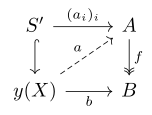
The square commutes, so $f(a)$ and $b$ agree on $S'$, and $f(a)=b$ because $B$ is a sheaf. The second claim is the lemma.
From projectives to extensive sites§
To extract a $\kappa$-extensive site from a topos with enough projectives, we use its projective objects that do not split into $\kappa$ non-initial summands. They form a $\kappa$-extensive category, and for large $\kappa$ this category is a site of the topos.
Definition 4.16 (κ-narrow object)§
For a cardinal $\kappa$, an object $X$ of a Grothendieck topos is $\kappa$-narrow if every coproduct decomposition $X\cong\coprod_{\alpha\in\kappa}X_\alpha$ has an initial $X_\alpha$. In words, $X$ is not a coproduct of $\kappa$ non-initial objects. See Definition 4.4 in Hora, Topos with enough projectives.
Example 4.17 (Narrow objects)§
An object $X$ is $2$-narrow if and only if it is initial or connected, and a set is $\kappa$-narrow if and only if its cardinality is less than $\kappa$. See Examples 4.6–4.7 in Hora, Topos with enough projectives.
Definition 4.18 (κ-narrow projectives)§
For a Grothendieck topos $\mathcal E$ and a regular cardinal $\kappa$, write $\mathcal C_\kappa\subseteq\mathcal E$ for the full subcategory of $\kappa$-narrow projective objects. See Definition 4.11 in Hora, Topos with enough projectives.
Lemma 4.19 (Counting summands)§☆
Let $\kappa\ge1$ be a cardinal. An object $X$ of a Grothendieck topos is $\kappa$-narrow if and only if every small coproduct decomposition $X\cong\coprod_{i\in I}X_i$ has fewer than $\kappa$ non-initial summands.
Proof§
The "if" part is immediate; we prove the contrapositive of "only if". Suppose $X_{i_\alpha}$ is non-initial for $\kappa$ distinct indices $i_\alpha$ ($\alpha\in\kappa$). Merging all other summands into $X_{i_0}$ gives a decomposition indexed by $\kappa$. None of its summands is initial, because the initial object of a topos is strict. So $X$ is not $\kappa$-narrow.
Lemma 4.20 (Decomposing narrow projectives)§☆
Let $\kappa$ be a regular cardinal and $P$ a $\kappa$-narrow projective object of a Grothendieck topos. A small family $\{f_i:X_i\to P\}_{i\in I}$ is jointly epimorphic if and only if $P\cong\coprod_{\lambda\in\Lambda}P_\lambda$ for a $\kappa$-small set $\Lambda$ such that each inclusion $P_\lambda\to P$ factors through some $f_i$. See Lemma 4.10 in Hora, Topos with enough projectives.
Proof§
For "if", the inclusions $P_\lambda\to P$ are jointly epimorphic and factor through the $f_i$. For "only if", $f=(f_i)_i:\coprod_iX_i\to P$ is an epimorphism, so it has a section $s$ because $P$ is projective. Pulling the coproduct back along $s$ gives $P\cong\coprod_{i\in I}P_i$, by infinitary extensivity:
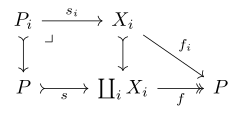
The bottom composite is $\mathrm{id}_P$, so the inclusion $P_i\to P$ is $f_is_i$. By the lemma, the set $\Lambda$ of $i$ with $P_i$ non-initial is $\kappa$-small, and $P\cong\coprod_{\lambda\in\Lambda}P_\lambda$.
Lemma 4.21 (Summands of projectives)§☆
In a Grothendieck topos, every summand of a projective object is projective. See Lemma 4.1 in Hora, Topos with enough projectives.
Proof§
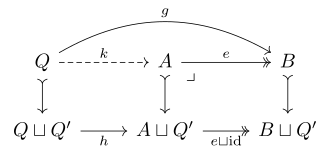
Let $Q\sqcup Q'$ be projective, $e:A\to B$ an epimorphism and $g:Q\to B$; we lift $g$ along $e$. Since $e\sqcup\mathrm{id}_{Q'}$ is an epimorphism, there is $h$ with $(e\sqcup\mathrm{id}_{Q'})h=g\sqcup\mathrm{id}_{Q'}$. So the outer rectangle below commutes, and its right square is a pullback by extensivity; this gives $k$ with $ek=g$.
Lemma 4.22 (Closure of narrow objects)§☆
Let $\kappa$ be a regular cardinal. The $\kappa$-narrow objects of a Grothendieck topos are closed under $\kappa$-small coproducts and under summands. See Proposition 4.9 in Hora, Topos with enough projectives.
Proof§
Both parts use the lemma. Let $X=\coprod_{\lambda\in\Lambda}X_\lambda$ with $|\Lambda|<\kappa$ and each $X_\lambda$ $\kappa$-narrow, and let $X\cong\coprod_{i\in I}Y_i$. By infinitary extensivity,
The set $I_\lambda$ of $i$ with $X_\lambda\times_XY_i$ non-initial is $\kappa$-small, and every non-initial $Y_i$ has $i\in\bigcup_\lambda I_\lambda$, which is $\kappa$-small as $\kappa$ is regular. For a summand $Q$ of a $\kappa$-narrow $X=Q\sqcup Q'$, a decomposition of $Q$ together with $Q'$ is a decomposition of $X$.
Lemma 4.23 (Closure of narrow projectives)§☆
Let $\mathcal E$ be a Grothendieck topos and $\kappa$ a regular cardinal. The subcategory $\mathcal C_\kappa\subseteq\mathcal E$ is closed under $\kappa$-small coproducts and under summands. See Lemma 4.1 and Proposition 4.9 in Hora, Topos with enough projectives.
Proof§
We combine the two lemmas above. A coproduct of projectives is projective, since $\mathcal E(\coprod_iP_i,-)\cong\prod_i\mathcal E(P_i,-)$, and a summand of a projective is projective by the lemma. The $\kappa$-narrow objects are closed under both operations by the lemma.
Lemma 4.24 (Essential smallness)§☆
For a Grothendieck topos $\mathcal E$ and a regular cardinal $\kappa$, the category $\mathcal C_\kappa$ is essentially small.
Proof§
Fix a small generating set $\mathcal G$ of $\mathcal E$. We show that each $P\in\mathcal C_\kappa$ is a $\kappa$-small coproduct of subobjects of objects of $\mathcal G$; these form a set up to isomorphism, as $\mathcal E$ is well-powered. The morphisms from objects of $\mathcal G$ to $P$ are jointly epimorphic, so the lemma gives $P\cong\coprod_{\lambda\in\Lambda}P_\lambda$ with $|\Lambda|<\kappa$ and each inclusion of the form $P_\lambda\to G\to P$ with $G\in\mathcal G$. Here $P_\lambda\to G$ is monic because the inclusion is.
Lemma 4.25 (Covering sieves of narrow projectives)§☆
Let $\mathcal E$ be a Grothendieck topos and $\kappa$ a regular cardinal. A sieve on $P$ in $\mathcal C_\kappa$ is jointly epimorphic in $\mathcal E$ if and only if it contains a $\kappa$-small coproduct diagram.
Proof§
A coproduct diagram is jointly epimorphic, which gives "if". Conversely, let $S$ be jointly epimorphic. The lemma gives $P\cong\coprod_{\lambda\in\Lambda}P_\lambda$ with $|\Lambda|<\kappa$ and each inclusion $P_\lambda\to P$ factoring through a member of $S$. Each $P_\lambda$ is a summand of $P$, so it lies in $\mathcal C_\kappa$ by the lemma, and its inclusion lies in the sieve $S$.
Proposition 4.26 (κ-narrow projectives)§☆
Let $\mathcal E$ be a Grothendieck topos and $\kappa$ a regular cardinal. Then $\mathcal C_\kappa$ is essentially small and $\kappa$-extensive, and the topology induced on it by the canonical topology of $\mathcal E$ coincides with $J_{\kappa\text{-ext}}$. See Theorem 4.13 in Hora, Topos with enough projectives.
Proof§
We combine the three lemmas above. By the closure lemma, $\mathcal C_\kappa$ has $\kappa$-small coproducts and the pullbacks $Y\times_XX_i$ of their inclusions, which are summands of $Y$; so it inherits $\kappa$-extensivity from the infinitary extensive category $\mathcal E$. It is essentially small by the lemma. A sieve on $P\in\mathcal C_\kappa$ covers for the induced canonical topology exactly when it is jointly epimorphic in $\mathcal E$, that is, by the lemma, when it lies in $J_{\kappa\text{-ext}}$.
Lemma 4.27 (Eventual narrowness)§☆
An object $X$ of a Grothendieck topos is $\kappa$-narrow for every cardinal $\kappa>|\mathrm{Sub}(X)|$.
Proof§
In a decomposition $X\cong\coprod_{i\in I}X_i$, distinct summands are disjoint subobjects of $X$, so the non-initial summands are pairwise distinct elements of $\mathrm{Sub}(X)$. Hence there are fewer than $\kappa$ of them, and the lemma applies.
Proposition 4.28 (Generating narrow projectives)§☆
A Grothendieck topos $\mathcal E$ has enough projectives if and only if $\mathcal C_\kappa$ is a generating full subcategory of $\mathcal E$ for some regular cardinal $\kappa$. See Theorem 4.13 in Hora, Topos with enough projectives.
Proof§
If $\mathcal C_\kappa$ is generating, every object receives an epimorphism from a coproduct of objects of $\mathcal C_\kappa$, which is projective. Conversely, suppose $\mathcal E$ has enough projectives, and choose epimorphisms $P_G\to G$ from projectives for $G$ in a small generating set; the $P_G$ are generating. By the lemma, they all lie in $\mathcal C_\kappa$ for every regular cardinal $\kappa$ larger than every $|\mathrm{Sub}(P_G)|$, for example an infinite successor cardinal.
Corollary 4.29 (Canonical site)§☆
If a Grothendieck topos $\mathcal E$ has enough projectives, then $\mathcal E\simeq\mathbf{Sh}(\mathcal C_\kappa,J_{\kappa\text{-ext}})$ for sufficiently large regular cardinals $\kappa$. See Corollary 4.14 in Hora, Topos with enough projectives.
Proof§
By the proposition, $\mathcal C_\kappa$ is generating for some regular $\kappa$. It stays generating for every regular $\kappa'\ge\kappa$, since $\mathcal C_\kappa\subseteq\mathcal C_{\kappa'}$ by the lemma. For such $\kappa'$, $\mathcal C_{\kappa'}$ is essentially small, and every object of $\mathcal E$ is covered, in the canonical topology, by objects of $\mathcal C_{\kappa'}$. The comparison lemma gives $\mathcal E\simeq\mathbf{Sh}(\mathcal C_{\kappa'},J)$ for the induced topology $J$, and $J=J_{\kappa'\text{-ext}}$ by the proposition on κ-narrow projectives.
Example 4.30 (Presheaf topoi)§
Let $\mathcal C$ be a small category with Cauchy completion $\overline{\mathcal C}$. The category $\mathcal C_2\subseteq\mathbf{PSh}(\mathcal C)$ is equivalent to $\overline{\mathcal C}^{\triangleleft}$, the category $\overline{\mathcal C}$ with a new initial object added. This reverses the construction in the corollary on presheaf topoi. See Example 4.12 in Hora, Topos with enough projectives.
5. Related concepts§
6. References§
- [Hor] Ryuya Hora, Topos with enough projectives, unpublished note.
- [CLW93] Aurelio Carboni, Stephen Lack and R. F. C. Walters, Introduction to extensive and distributive categories, J. Pure Appl. Algebra 84 (1993), no. 2, 145–158.