 duaLab
Finite presheaf topos
Contents
For a small category $\mathcal C$, the category $\mathbf{fPSh}(\mathcal C)=[\mathcal C^{\mathrm{op}},\mathbf{FinSet}]$ of finite presheaves is finitely complete, but it need not be cartesian closed or a topos. The question of when it is a topos comes from the theory of riegs: the isomorphism classes of a finite presheaf topos form a rieg, its Burnside rieg.
1. Idea§
The isomorphism classes of the objects of a cartesian closed category with finite coproducts form a rieg, its Burnside rieg. The finite presheaves on a small category have finite limits and finite colimits, so they give a rieg as soon as they form a cartesian closed category. In the following table, the last column says whether this holds.
So we ask for which small categories the finite presheaves form a cartesian closed category, and for which they form a topos. See Example 4.1.8 and the question after it in [Hor26].
2. Definition§
We name the properties of a small category that we compare.
Definition 2.1 (Finite presheaf)§
A finite presheaf on a small category $\mathcal C$ is a functor $\mathcal C^{\mathrm{op}}\to\mathbf{FinSet}$, that is, a presheaf whose values are finite sets. The finite presheaves form the full subcategory $\mathbf{fPSh}(\mathcal C)=[\mathcal C^{\mathrm{op}},\mathbf{FinSet}]$ of the presheaf topos $\mathbf{PSh}(\mathcal C)$.
Definition 2.2 (ICCC, IET, LIET)§
A small category $\mathcal C$ is
- ICCC (inducing a cartesian closed category) if $\mathbf{fPSh}(\mathcal C)$ is cartesian closed;
- IET (inducing an elementary topos) if $\mathbf{fPSh}(\mathcal C)$ is an elementary topos;
- LIET (logically inducing an elementary topos) if $\mathbf{fPSh}(\mathcal C)$ is an elementary topos and the inclusion $\mathbf{fPSh}(\mathcal C)\to\mathbf{PSh}(\mathcal C)$ is a logical functor, that is, it preserves finite limits, exponentials and the subobject classifier.
Remark 2.3 (Implications)§
Every LIET category is IET, and every IET category is ICCC, because an elementary topos is cartesian closed. In the following diagram, the struck arrow is the implication that fails, by the examples below, and the arrow marked $?$ is the open problem.

Definition 2.4 (Finitary Morita equivalence)§
Two small categories $\mathcal C$ and $\mathcal D$ are finitely Morita equivalent if $\mathbf{fPSh}(\mathcal C)\simeq\mathbf{fPSh}(\mathcal D)$.
3. Properties§
We characterize LIET, give a necessary condition for IET, and show that LIET passes along discrete fibrations.
Characterization of LIET§
A small category is LIET exactly when each of its slice categories has finitely many objects up to isomorphism. The proof counts the subobjects of the presheaves $A\times y(c)$, for a finite presheaf $A$ and the presheaf $y(c)$ represented by an object $c$.
Lemma 3.1 (LIET and subobjects)§☆
A small category $\mathcal C$ is LIET if and only if, for every finite presheaf $A$ and every object $c$, the presheaf $A\times y(c)$ has only finitely many subobjects in $\mathbf{PSh}(\mathcal C)$.
Proof§
Both directions compare values of exponentials in $\mathbf{PSh}(\mathcal C)$, and of its subobject classifier $\Omega$, with sets of subobjects:
where the embedding takes graphs. If $\mathcal C$ is LIET, the logical inclusion preserves $\Omega^A$, so it is finite for finite $A$. Conversely, the bijection for $A=1$ and the embedding make $\Omega$ and $B^A$ finite for finite $A$ and $B$. As $\mathbf{fPSh}(\mathcal C)$ is closed under finite limits and subobjects, it is then a topos with logical inclusion.
Lemma 3.2 (Slices bound subobjects)§☆
Let $A$ be a finite presheaf and $c$ an object such that $\mathcal C/c$ has finitely many isomorphism classes of objects, with representatives $(d_k,f_k)$. Then $\#\mathrm{Sub}(A\times y(c))\le\prod_k2^{\#A(d_k)}$.
Proof§
A subpresheaf $S\subseteq A\times y(c)$ is determined by the sets $\{a\mid(a,f_k)\in S\}\subseteq A(d_k)$. Indeed, an element of $(A\times y(c))(d)$ is a pair $(a,f)$ with $a\in A(d)$ and $f:d\to c$, and for some $k$ an isomorphism $\varphi:d_k\cong d$ has $f\varphi=f_k$. Since $S$ is closed under restriction along $\varphi$ and $\varphi^{-1}$, it contains $(a,f)$ if and only if it contains $(A(\varphi)a,f_k)$.
Lemma 3.3 (Dedekind-finite endomorphisms)§☆
If an object $d$ of a category has only finitely many sieves, then the monoid $\mathrm{End}(d)$ is Dedekind-finite: $uv=\mathrm{id}_d$ implies $vu=\mathrm{id}_d$.
Proof§
We find a right inverse of $v$ by the pigeonhole principle. The sieves $\langle v^n\rangle$ generated by the powers of $v$ are not all distinct, so $\langle v^n\rangle=\langle v^m\rangle$ for some $n<m$. Then $v^n\in\langle v^m\rangle\subseteq\langle v^{n+1}\rangle$, say $v^n=v^{n+1}h$, and composing with $u^n$ on the left gives $\mathrm{id}_d=vh$. Hence $u=uvh=h$ and $vu=\mathrm{id}_d$.
Lemma 3.4 (Slices embed into subobjects)§☆
Suppose that every endomorphism monoid of $\mathcal C$ is Dedekind-finite. Let $N_d$ be the sieve of morphisms into $d$ that are not split epimorphisms and, for $f:d\to c$, let $\Gamma_f\subseteq\Omega\times y(c)$ be the subpresheaf generated by $(N_d,f)$. If $\Gamma_f=\Gamma_{f'}$ for $f':d'\to c$, then $(d,f)\cong(d',f')$ in $\mathcal C/c$.
Proof§
The elements of $\Gamma_f$ are the $(g^*N_d,fg)$ for $g:e\to d$. So $(N_{d'},f')\in\Gamma_f$ and $(N_d,f)\in\Gamma_{f'}$ give $g$ and $g'$ with $g^*N_d=N_{d'}$ and $g'^*N_{d'}=N_d$ making both triangles commute.
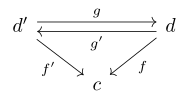
As $\mathrm{id}_{d'}\notin N_{d'}$, we get $g\notin N_d$, so $g$ is a split epimorphism; likewise $g'$. Then $gg'$ and $g'g$ are split epimorphisms, hence invertible by Dedekind-finiteness, and $g$ is an isomorphism over $c$.
Proposition 3.5 (Characterization of LIET)§☆
For a small category $\mathcal C$, the following are equivalent:
- the category $\mathcal C$ is LIET;
- for every finite presheaf $A$ and every object $c$, the presheaf $A\times y(c)$ has only finitely many subobjects in $\mathbf{PSh}(\mathcal C)$;
- every slice category has only finitely many isomorphism classes of objects: $\#\bigl(\mathrm{ob}(\mathcal C/c)/{\cong}\bigr)<\infty$ for every object $c$.
Proof§
The first two conditions are equivalent by the lemma, and the third implies the second by the bound. Conversely, assume the second. Then $\Omega$ is a finite presheaf: the elements of $\Omega(d)$ are the sieves on $d$, that is, the subobjects of $y(d)$. So the endomorphism monoids are Dedekind-finite, and the isomorphism classes of $\mathcal C/c$ embed into $\mathrm{Sub}(\Omega\times y(c))$, which is finite.
Remark 3.6 (Sources)§
The equivalence of the first two conditions is due to Jérémie Marquès; compare Engenes 1974, Lemma 1 for locally finite $\mathcal C$. That essentially finite slices suffice is essentially shown in Engenes 1974; see also Johnstone, Sketches of an Elephant, Example A2.1.5. This includes the classical cases of finite categories and groups (Mac Lane–Moerdijk; Borceux, Handbook of Categorical Algebra 3; Engenes 1974, p. 147).
A necessary condition for IET§
For a category with a suitable object $t$, the finite presheaves can form a topos only if each of them has values of bounded size. This shows that many familiar categories are not IET.
Definition 3.7 (Bounded functor)§
A functor $F$ from a small category to $\mathbf{FinSet}$ is bounded if there is a natural number $n$ such that $\#F(c)\le n$ for every object $c$.
Lemma 3.8 (A chain of subobjects)§☆
Let $A$ be a finite presheaf on $\mathcal C$, and let $B$ be the presheaf of subsets $B(c)=\mathcal P(A(c))$, with $B(g)$ the direct image along $A(g)$. If there is a morphism $f:c\to t$, then $y(t)\times B$ has at least $\#A(c)+1$ subobjects.
Proof§
We exhibit distinct subpresheaves $S_0,\dots,S_{\#A(c)}$. Let $S_k\subseteq y(t)\times B$ be generated by the elements $(f,U)$ with $U\subseteq A(c)$ and $\#U\le k$, so that its elements are the $(fg,B(g)U)$. Then $(f,V)\in S_k$ if and only if $\#V\le k$: every such $V$ occurs for $g=\mathrm{id}_c$, and direct images do not increase size.
Lemma 3.9 (Variance)§☆
For a small category $\mathcal C$, every functor $\mathcal C^{\mathrm{op}}\to\mathbf{FinSet}$ is bounded if and only if every functor $\mathcal C\to\mathbf{FinSet}$ is bounded.
Proof§
Compose with the contravariant power set functor $X\mapsto\mathcal P(X)$ on $\mathbf{FinSet}$, acting by inverse images. It turns functors on $\mathcal C$ into functors on $\mathcal C^{\mathrm{op}}$, and conversely. A family of finite sets $X$ is bounded if and only if the family of the $\mathcal P(X)$ is, so an unbounded functor of one variance gives an unbounded functor of the other.
Proposition 3.10 (Bounded finite presheaves)§☆
Suppose $\mathcal C$ has an object $t$ with $0<\#\mathcal C(c,t)<\infty$ for every object $c$. If $\mathcal C$ is IET, then every functor $\mathcal C^{\mathrm{op}}\to\mathbf{FinSet}$ is bounded. Moreover, every functor $\mathcal C^{\mathrm{op}}\to\mathbf{FinSet}$ is bounded if and only if every functor $\mathcal C\to\mathbf{FinSet}$ is bounded.
Proof§
We bound the values of a finite presheaf $A$ by the number of subobjects of a single finite presheaf. With $B$ as in the lemma, $y(t)$ and $B$ are finite, and $B$ has a power object $PB$ in the topos $\mathbf{fPSh}(\mathcal C)$. Subpresheaves of finite presheaves are finite, so
Every object $c$ has a morphism to $t$, so $\#A(c)+1\le N$ by the lemma. The equivalence is the lemma on variance.
Discrete fibrations§
By the characterization by slices, the property LIET passes along functors that induce isomorphisms of slice categories.
Proposition 3.11 (Discrete fibrations)§☆
Let $F\colon\mathcal C\to\mathcal D$ be a discrete right fibration, that is, a discrete fibration: for every object $x$ of $\mathcal C$, every morphism $d\to Fx$ of $\mathcal D$ has exactly one lift to a morphism of $\mathcal C$ with codomain $x$. Then $\mathcal C/x\cong\mathcal D/Fx$ for every object $x$. So if $\mathcal D$ is LIET, then so is $\mathcal C$; and if $F$ is surjective on objects and $\mathcal C$ is LIET, then so is $\mathcal D$.
This was conjectured in [HM24].
Proof§
Unique lifting makes the functor $(z,k)\mapsto(Fz,Fk)$ from $\mathcal C/x$ to $\mathcal D/Fx$ bijective on objects and, as follows, on morphisms. Given $n$ as below, lift it to $\tilde n$ with codomain $z_2$. Then $k_2\tilde n$ and $k_1$ both lift $F(k_1)$ into $x$, so they coincide; thus $\tilde n$ has domain $z_1$ and is the unique morphism of $\mathcal C/x$ over $n$.
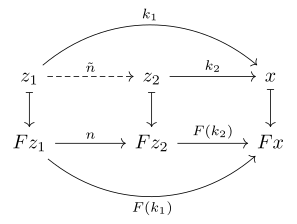
Both claims follow from the characterization of LIET by slices, every object of $\mathcal D$ being some $Fx$ for surjective $F$.
4. Examples§
The examples separate LIET from IET. No category is known that is ICCC but not IET.
Example 4.1 (LIET)§
- Finite categories and groups are LIET.
- A monoid $M$ with group of units $M^\times$ is LIET if and only if the set $\{mM^\times\mid m\in M\}$ is finite.
- For an infinite field $K$, the multiplicative monoid $(K,\cdot)$ is LIET, since $\{mK^\times\mid m\in K\}=\{\{0\},K^\times\}$. Its slice category is not essentially finite: the object $0$ has the infinite endomorphism monoid $K$.
- A poset $P$ is LIET if and only if it is IET, if and only if every down-set $\{q\mid q\le p\}$ is finite.
For ordinals, the statement on posets is in Engenes 1974, pp. 147–148.
Example 4.2 (IET but not LIET)§
- The category $\mathbf{Set}$ is IET but not LIET. Every functor $G\colon\mathbf{Set}^{\mathrm{op}}\to\mathbf{FinSet}$ is, on nonempty sets, naturally isomorphic to the constant functor at $G(1)$, so $\mathbf{fPSh}(\mathbf{Set})\simeq\mathbf{FinSet}^{\to}$. The same holds for every full subcategory of $\mathbf{Set}$ that contains $1$ and an infinite set.
- The additive monoid $[0,\infty)$ is IET but not LIET. The proof uses the following puzzle: the positive reals cannot be colored with finitely many, but more than one, colors so that $a+c$ and $b+c$ have the same color whenever $a$ and $b$ do.
Example 4.3 (Not IET)§
- By the boundedness criterion, the simplex category $\Delta$ and the categories of finite rings, of finite groups and of finite posets are not IET.
- The categories $\mathbf{FinSet}$ and $\mathbf{FinSet}^{\mathrm{op}}$ are not even ICCC; see Engenes 1974, Corollary 2.
- The additive monoid $(\mathbb N,0,+)$ is not even ICCC. Its finite presheaves are finite discrete dynamical systems. It is a subcategory of the group $\mathbb Z$, which is LIET, so IET categories are not closed under subcategories.
Example 4.4 (Finitary Morita equivalence)§
- Let $G$ be a group and $N$ the intersection of all its finite-index subgroups. Then $N$ is normal, and $G\to G/N$ is a finitary Morita equivalence.
- The additive group $\mathbb Q$ is finitely Morita equivalent to the trivial group, so $\mathbf{fPSh}(\mathbb Q)\simeq\mathbf{FinSet}$.
- The additive monoid $[0,\infty)$ is finitely Morita equivalent to the multiplicative monoid $\{0,1\}$.
- The functor $\mathbf{Set}\to\{0\to1\}$ sending $\emptyset$ to $0$ and every nonempty set to $1$ is a finitary Morita equivalence.
5. Open problems§
The properties LIET and IET are different, but ICCC and IET are not yet separated.
Problem 5.1 (ICCC and IET)§
Is ICCC equivalent to IET? That is, is there a small category whose finite presheaves form a cartesian closed category that is not a topos?
6. Related concepts§
- Rieg
- locally finite topos
7. References§
- [Eng74] Hans Engenes, Subobject classifiers and classes of subfunctors, Mathematica Scandinavica 34 (1974), 145–152.
- [HM24] Ryuya Hora and Jérémie Marquès, When do finite presheaves form a topos?, unpublished draft (2024).
- [Hor26] Ryuya Hora, Notes on Rieg theory: semiring with exponentials in logic, profinite arithmetic, enumerative combinatorics, and category theory, prepreprint v0.1 (2026).
- [Joh02] P. T. Johnstone, Sketches of an Elephant, Oxford University Press (2002), Vol. 1, Example A2.1.5; Vol. 2, C2.2.22.