 duaLab
Double category of games
Project: Games as recursive coalgebras
Contents
A morphism of partisan games maps positions and preserves the options of each player. A strategy gives replies when two games are played side by side. A double category lets us compare strategies along morphisms of their games.
1. Idea§
A square compares a top strategy $S$ from $X$ to $Y$ with a bottom strategy $T$ from $X'$ to $Y'$. Its left and right edges are game morphisms $f:X\to X'$ and $g:Y\to Y'$. Inside the square is a simulation: a map $S\to T$ of state sets that respects both positions and replies. This is the state-based construction considered here. Joyal's construction uses winning strategies from a specified starting position.
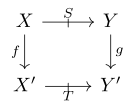
Stacking squares composes simulations. Placing squares side by side composes the strategies by interaction and pairs their state maps. Regrouping three strategies rebrackets the triples of states, so the horizontal composition is associative up to a specified isomorphism.
2. Construction§
A game morphism $f:X\to Y$ sends the state $x$ of the copycat strategy on $X$ to the state $f(x)$ of copycat on $Y$. This gives its horizontal identity square, with $f$ on both vertical sides.
Lemma 2.1 (Interaction respects simulations)§☆
Given two squares side by side, the pair of their state maps is a simulation between the composites of the top and bottom strategies.
Proof§
The shared board maps agree, so the pair of state maps preserves the matching condition and the external positions. A board map sends a legal move to a legal move on the same board. The simulation equations therefore commute with each reply in the interaction. Iterating them commutes with the final reply and the resulting pair of states.
Proposition 2.2 (A double category of partisan games)§☆
Partisan games, their morphisms as vertical arrows, strategies as horizontal arrows, and simulations as squares form a pseudo double category. Horizontal composition is interaction, with copycat as the horizontal unit.
Proof§
By the lemma, horizontal composition pairs the state maps, so it respects vertical composition. For either grouping of three strategies, an internal reply goes to the adjacent strategy, so the two executions agree. The interaction terminates since each internal board has only finite plays. Rebracketing states therefore preserves replies. Copycat forwards every move across its two boards, so omitting its state gives the unit isomorphisms. Naturality, the pentagon and the triangle follow because each route acts identically on the ordered lists of remaining states.
Example 2.3 (Strategies on a terminal position)§
Take the game $0$ consisting of one position with no moves. Every set of states gives a strategy from $0$ to $0$, and every function between such sets gives a simulation over the identity maps of the boards. Joyal's game $0$ has one winning strategy from its initial position against itself. See Joy77, Winning Strategy.
3. Companions and conjoints§
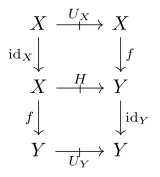
A companion of a vertical game morphism $f:X\to Y$ is a strategy $H$ from $X$ to $Y$ with these squares, using copycat $U_X,U_Y$. Require the vertical composite to be the horizontal identity square on $f$, and the horizontal composite to be the identity on $H$ under the unit identifications. A conjoint reverses the horizontal direction.
Lemma 3.1 (A square out of copycat forces injectivity)§☆
Let $f:X\to Y$ be a partisan game morphism. If a simulation from copycat on $X$ to a strategy from $X$ to $Y$ has vertical sides $(\mathrm{id}_X,f)$, then $f$ is injective on Right options at every position of $X$.
Proof§
Suppose distinct Right options $a,b$ at $x$ have $f(a)=f(b)$. Right can move on the second copy from $(x,x)$ to $(x,a)$ or $(x,b)$. Copycat's response states are $a$ and $b$. After applying the board maps these two Right moves coincide, so the simulation must identify the response states. Their images have different first coordinates $a$ and $b$, which is impossible.
Lemma 3.2 (Squares for the graph strategy)§☆
Let $f:X\to Y$ be a partisan game morphism that is injective on the Right options at each position. The two maps of states $\mathrm{id}_X$ and $f$ give the two displayed squares when $H$ is the strategy over the graph of $f$.
Proof§
In the first square, a move in the second copy of $X$ maps to a move in $Y$. The lifting rule of $H$ returns the original option by injectivity. In the second square, each lifted reply maps back to the original option in $Y$. For moves in the other coordinate, both squares preserve the reply because $H$ applies $f$ directly.
Proposition 3.3 (When a morphism has a companion or conjoint)§☆
A morphism $f:X\to Y$ of partisan games has a companion if and only if $f$ is injective on the Right options at every position of $X$. It has a conjoint if and only if $f$ is injective on the Left options at every position of $X$.
Proof§
Use the graph strategy and its two squares. Their vertical composite is $f$, and their horizontal composite $(x,x)\mapsto(x,f(x))$ becomes the identity under the unit identifications. The lemma gives necessity. Swapping the two boards and taking the dual of each game reverses horizontal arrows and exchanges Left and Right, giving the conjoint criterion.
4. Open problems§
Problem 4.1 (Comparison with Joyal's category)§
How does the horizontal bicategory of strategies and simulations over identity board maps compare with Joyal's category of games and winning strategies? This is the comparison in Problem 5.0.2 of [Hor].
Question 4.2 (Nondeterministic strategies)§
Let a strategy give a nonempty set of answers to each move, and let simulations preserve answers only up to inclusion. Does every morphism of partisan games then have a companion?
5. Related concepts§
- Strategy · Games · Games as recursive coalgebras · PGames
- Question on the internal hom of the Conway addition
- double category · compact closed category
6. References§
- [Hor] Ryuya Hora, list of research problems on his former homepage, Problem 5.0.2.
- [Hor25] Ryuya Hora, Games as recursive coalgebras: A categorical view on the Nim-sum, arXiv:2510.22886, §5.4.1.
- [Joy77] André Joyal, Remarques sur la théorie des jeux à deux personnes, Gazette des sciences mathématiques du Québec 1(4) (1977), 46–52; English translation by Robin Houston (2003).