 duaLab
Classifying topos of a first-order theory
Project: Moduli spaces of mathematics
Contents
1. Idea§
When does an existence statement supply a witness that can be defined without parameters? If this works in every model of a theory, the definable elements give a prime model for each complete extension of the theory. These prime models form a section over the space of completions, and restricting a sheaf along this section computes its direct image on that space.
2. Setup§
Let $T$ be a consistent classical first-order theory in a set-sized signature with inhabited sorts. Let $E_T$ be the classifying topos of its full classical Morleyization. Let $S_T$ be the Stone space of completions of $T$. Write $p:E_T\to\mathrm{Sh}(S_T)$ for the localic reflection, which sends each model to its complete theory. Here $\mathrm{Sh}(S_T)$ is the topos of sheaves on $S_T$.
3. Properties§
Lemma 3.1 (Definable witnesses from projectivity)§☆
If the terminal object of $E_T$ is projective, the parameter-free definable elements of every set-based model of $T$ form an elementary submodel.
Proof§
For a parameter-free formula $\varphi(x)$, let $W$ be its syntactic object and $U$ the subterminal for $\exists x\,\varphi(x)$. The coproduct of $W$ and the complementary subterminal of $U$ covers the terminal object. A splitting restricts over $U$ to a map $U\to W$. By full faithfulness of the syntactic embedding, this map gives a parameter-free formula defining a single witness whenever one exists. The definable elements are closed under the operations of the language. Replacing definable parameters by their defining formulas allows the Tarski–Vaught test to apply.
Lemma 3.2 (The sheaf of definable elements)§☆
Suppose the parameter-free definable elements in every set-based model of $T$ form an elementary submodel. There is a model in $\mathrm{Sh}(S_T)$ whose stalk at each completion is that definable submodel of every model of the completion, up to unique isomorphism.
Proof§
Over the clopen where a formula defines a unique element, take its unique witness as a local section of the relevant sort. Identify two sections over the clopen where the two formulas define the same element. These charts give an étalé space for each sort. Interpret functions and Morley predicates on the charts by the clopen loci of the corresponding sentences. The stalks are the definable submodels by construction and satisfy the axioms by hypothesis, so the resulting sheaves form a model.
Lemma 3.3 (Direct images from the definable submodels)§☆
Suppose the parameter-free definable elements in every set-based model of $T$ form an elementary submodel. The sheaf of definable elements classifies a section $s$ of $p$. Its inverse image $s^*$ is naturally isomorphic to the direct image $p_*$.
Proof§
The classifying morphism $s$ is a section because its model has the prescribed complete theory at each stalk. Over each pulled-back clopen, the generic model satisfies the sentences specifying the unique witnesses and their Morley predicates. Evaluation therefore gives a model homomorphism inducing the counit $p^*s^*\to\mathrm{id}_{E_T}$.
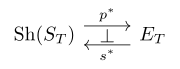
Take the unit from $s^*p^*\cong\mathrm{id}$. Applying $s^*$ to the counit evaluates each definition in its own chart and gives the identity. The counit on the image of $p^*$ is the identity on subterminals, which have only the identity endomorphism, and hence on their colimits. These are the triangle identities.
Proposition 3.4 (Projectivity and the section of prime models)§☆
The following are equivalent for $T$ and its classifying topos $E_T$.
- The parameter-free definable elements in every set-based model of $T$ form an elementary submodel.
- The terminal object of $E_T$ is projective.
- The localic reflection $p$ has a section $s$ such that the direct image $p_*$ is naturally isomorphic to the inverse image $s^*$.
Under condition 1, the section in condition 3 can be taken to be the family of prime models formed by the definable elements.
Proof§
The definable witnesses lemma gives $2\Rightarrow 1$ and the direct image lemma gives $1\Rightarrow 3$. Under condition 1, a stalk has a unique elementary embedding into each model of its completion because the defining formulas determine the image of each element.
For $3\Rightarrow 2$, an epimorphism onto the terminal object pulls back along $s$ to a sheaf with local sections. Compactness and the clopen basis give a finite disjoint clopen refinement on which the sections glue. The isomorphism $p_*\cong s^*$ turns the resulting global section into a splitting in $E_T$.
Corollary 3.5 (Vanishing of higher cohomology)§☆
If the terminal object of $E_T$ is projective, then $H^n(E_T,A)=0$ for every abelian sheaf $A$ and every positive integer $n$. Here $H^n$ denotes sheaf cohomology.
Proof§
For an epimorphism of abelian sheaves, pull it back along a global section of its target. The resulting epimorphism onto the terminal object splits, so the section lifts. Thus global sections are exact on abelian sheaves.
4. Examples§
5. Related concepts§
—
6. References§
—